Pearson+ LogoPearson+ Logo
Ch. 6 - A Tour of the Cell
Campbell - Campbell Biology 11th Edition
Urry11th EditionCampbell BiologyISBN: 9789357423311Not the one you use?Change textbook
Chapter 6, Problem 5

Which cell would be best for studying lysosomes?
a. Muscle cell
b. Nerve cell
c. Bacterial cell
d. Phagocytic white blood cell

Verified step by step guidance
1
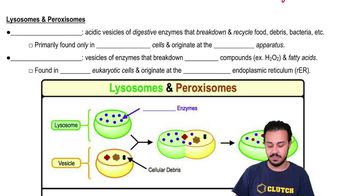
Understand the function of lysosomes: Lysosomes are organelles that contain digestive enzymes to break down waste materials and cellular debris. They are involved in processes such as autophagy and the destruction of pathogens.
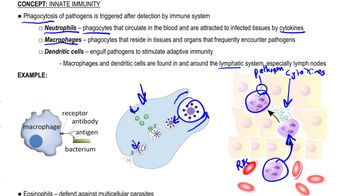
Consider the role of phagocytic white blood cells: These cells are part of the immune system and are responsible for engulfing and digesting pathogens and debris. They rely heavily on lysosomes to perform these functions.
Compare the presence of lysosomes in different cell types: Muscle cells and nerve cells have specific functions related to movement and signal transmission, respectively, and do not primarily rely on lysosomes for their main activities. Bacterial cells do not have lysosomes as they are prokaryotic cells.
Evaluate the need for lysosomes in phagocytic white blood cells: Given their role in digesting foreign particles and pathogens, phagocytic white blood cells have a high concentration of lysosomes to facilitate these processes.
Conclude that phagocytic white blood cells are the best choice for studying lysosomes due to their reliance on these organelles for immune functions.

Verified video answer for a similar problem:

This video solution was recommended by our tutors as helpful for the problem above.
Video duration:
38s
Was this helpful?

Key Concepts

Here are the essential concepts you must grasp in order to answer the question correctly.

Lysosomes

Lysosomes are membrane-bound organelles found in eukaryotic cells that contain enzymes for digesting cellular waste, pathogens, and other materials. They play a crucial role in cellular homeostasis and recycling of cellular components. Understanding lysosomes is essential for studying their function in different cell types, particularly those involved in immune responses.
Recommended video:
Guided course
05:38
Lysosomes & Peroxisomes

Phagocytosis

Phagocytosis is the process by which certain cells, like phagocytic white blood cells, engulf and digest foreign particles, bacteria, and dead or dying cells. This process is closely linked to lysosomal activity, as lysosomes fuse with phagosomes to break down the engulfed material. Phagocytic cells are ideal for studying lysosomes due to their active role in digestion and immune defense.
Recommended video:
Guided course
06:47
Innate Immune Cells

Cell Types

Different cell types have varying functions and organelle compositions. Muscle and nerve cells are specialized for contraction and signal transmission, respectively, and have fewer lysosomes compared to phagocytic white blood cells. Bacterial cells lack lysosomes entirely, as they are prokaryotic. Thus, phagocytic white blood cells are the best choice for studying lysosomes due to their abundance and activity in these cells.
Recommended video:
Guided course
01:01
Types of Cell Signaling