
Pearson+ LogoPearson+ Logo
Ch. 9 - Cellular Respiration and Fermentation
Campbell - Campbell Biology 11th Edition
Urry11th EditionCampbell BiologyISBN: 9789357423311Not the one you use?Change textbook
Chapter 9, Problem 1

The immediate energy source that drives ATP synthesis by ATP synthase during oxidative phosphorylation is the
a. Oxidation of glucose and other organic compounds.
b. Flow of electrons down the electron transport chain.
c. H+ concentration gradient across the membrane holding ATP synthase.
d. Transfer of phosphate to ADP.

Verified step by step guidance
1
Understand the process of oxidative phosphorylation, which occurs in the mitochondria during cellular respiration.
Recognize that ATP synthase is an enzyme that synthesizes ATP from ADP and inorganic phosphate.
Identify the role of the electron transport chain, which creates a proton (H+) gradient across the inner mitochondrial membrane.
Learn that the immediate energy source for ATP synthesis by ATP synthase is the proton gradient, which drives the flow of protons through ATP synthase.
Conclude that the correct answer is related to the H+ concentration gradient across the membrane holding ATP synthase, as this gradient provides the energy for ATP synthesis.

Verified video answer for a similar problem:

This video solution was recommended by our tutors as helpful for the problem above.
Video duration:
2m
Was this helpful?

Key Concepts

Here are the essential concepts you must grasp in order to answer the question correctly.

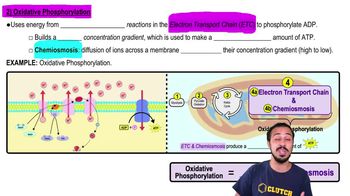
Oxidative Phosphorylation

Oxidative phosphorylation is the process by which ATP is formed as electrons are transferred from NADH or FADH2 to O2 by a series of electron carriers. This occurs in the mitochondria and involves the electron transport chain and chemiosmosis, ultimately driving ATP synthesis through ATP synthase.
Recommended video:
Guided course
06:27
Oxidative Phosphorylation

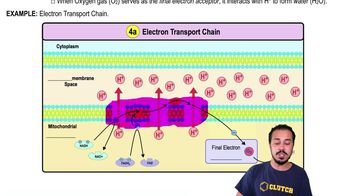
Electron Transport Chain

The electron transport chain is a series of protein complexes located in the inner mitochondrial membrane. Electrons are passed through these complexes, releasing energy used to pump protons across the membrane, creating a proton gradient. This gradient is crucial for ATP production during oxidative phosphorylation.
Recommended video:
Guided course
07:41
Electron Transport Chain

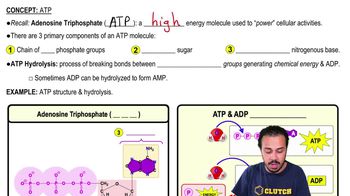
Proton Gradient and ATP Synthase

The proton gradient across the mitochondrial membrane is essential for ATP synthesis. As protons flow back into the mitochondrial matrix through ATP synthase, the energy released drives the conversion of ADP to ATP. This process, known as chemiosmosis, is the immediate energy source for ATP synthesis during oxidative phosphorylation.
Recommended video: