Pearson+ LogoPearson+ Logo
Ch. 9 - Cellular Respiration and Fermentation
Campbell - Campbell Biology 11th Edition
Urry11th EditionCampbell BiologyISBN: 9789357423311Not the one you use?Change textbook
Chapter 9, Problem 4

In mitochondria, exergonic redox reactions
a. Are the source of energy driving prokaryotic ATP synthesis.
b. Provide the energy that establishes the proton gradient.
c. Reduce carbon atoms to carbon dioxide.
d. Are coupled via phosphorylated intermediates to endergonic processes.

Verified step by step guidance
1
Understand the role of mitochondria in cellular respiration, where they are responsible for producing ATP through oxidative phosphorylation.
Recognize that exergonic redox reactions in mitochondria involve the transfer of electrons, which releases energy.
Identify that this released energy is used to pump protons across the mitochondrial membrane, creating a proton gradient.
Learn that the proton gradient is crucial for ATP synthesis, as it drives the enzyme ATP synthase to convert ADP and inorganic phosphate into ATP.
Note that the correct answer involves the establishment of the proton gradient, which is a key step in the process of ATP production in mitochondria.

Verified video answer for a similar problem:

This video solution was recommended by our tutors as helpful for the problem above.
Video duration:
1m
Was this helpful?

Key Concepts

Here are the essential concepts you must grasp in order to answer the question correctly.

Exergonic Redox Reactions

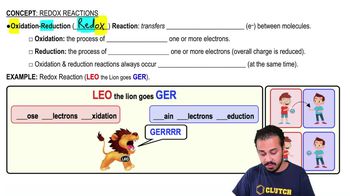
Exergonic redox reactions involve the transfer of electrons between molecules, releasing energy in the process. In mitochondria, these reactions are crucial for cellular respiration, where electrons are transferred from NADH and FADH2 to oxygen, driving the production of ATP. This energy release is essential for establishing the proton gradient across the mitochondrial membrane.
Recommended video:
Guided course
04:47
Redox Reactions

Proton Gradient

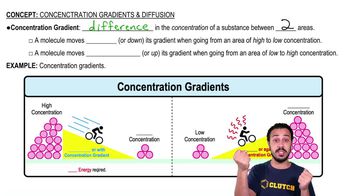
The proton gradient is a difference in proton concentration across the inner mitochondrial membrane, created by the electron transport chain during cellular respiration. This gradient is a form of potential energy, used by ATP synthase to synthesize ATP from ADP and inorganic phosphate. The movement of protons back into the mitochondrial matrix drives this process, highlighting the importance of the gradient in energy production.
Recommended video:
Guided course
04:51
Concentration Gradients and Diffusion

Coupling of Reactions

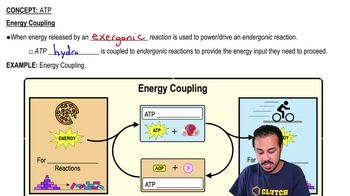
Coupling of reactions refers to the linking of exergonic and endergonic processes, allowing energy released from one reaction to drive another. In mitochondria, phosphorylated intermediates often facilitate this coupling, ensuring that energy from exergonic redox reactions is efficiently used for ATP synthesis. This concept is vital for understanding how cells manage energy and maintain metabolic balance.
Recommended video:
Guided course
04:57
Energy Coupling