
Imagine discovering a loss-of-function mutation in a eukaryotic gene. You determine the gene's nucleotide sequence from the start site for transcription to the termination point of transcription and find no differences from the wild-type sequence. Explain where you think the mutation might be and how the mutation might be acting.
In the follow-up work to the experiment shown in Figure 19.6, the researchers used a technique that allowed them to see if two DNA sequences are in close physical proximity (association). They applied this method to examine how often an enhancer and the core promoter of the Hnf4a regulatory gene were near each other. A logical prediction is that compared with rats born to mothers fed a healthy diet, the Hnf4a gene in rats born to mothers fed a protein-poor diet would

a. Show no difference in how often the promoter and enhancer associated
b. Never show any promoter–enhancer association
c. Show a lower frequency of promoter–enhancer association
d. Show a higher frequency of promoter–enhancer association
Verified step by step guidance
Verified video answer for a similar problem:
Key Concepts
Epigenetics
Promoter-Enhancer Interaction
Histone Modifications
The following statements are about the control of chromatin condensation. Select True or False for each.
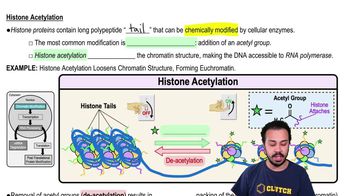
T/F Reducing histone acetylase activity is likely to decrease gene transcription.
T/F Mutations that reduce the number of positively charged amino acids on histones should promote open chromatin.
T/F Chromatin remodeling complexes add chemical groups to histones.
T/F Adding an inhibitor of DNA methylation is likely to reduce gene transcription.
Predict how a mutation that caused continuous production of active p53 would affect the cell.
Imagine repeating the experiment on epigenetic inheritance that is shown in Figure 19.6. You measure the amount of radioactive uridine (U) incorporated into Hnf4a mRNA in counts per minute (cpm) to determine the level of Hnf4a gene transcription in rats born to mothers fed either a normal diet or a low-protein diet. The results are 11,478 cpm for the normal diet and 7368 cpm for the low-protein diet. For this problem, your task is to prepare a graph similar to the one at the bottom of Figure 19.6 that shows the normalized results for the low-protein diet relative to the normal diet. Normalizing values means that the value obtained from one condition is expressed as 1.0 (the norm; the normal diet in this case) and the values obtained from any other conditions (low-protein diet in this case) are expressed as decimal values relative to the norm.
