Pearson+ LogoPearson+ Logo
Ch. 20 - The Molecular Revolution: Biotechnology, Genomics, and New Frontiers
Freeman - Biological Science 8th Edition
Freeman8th EditionBiological ScienceISBN: 9780138276263Not the one you use?Change textbook
Chapter 20, Problem 4

The human genome size is 3 billion base pairs, and the size of the baker's yeast genome, a single-celled organism, is 12 million base pairs. Therefore, the predicted genome size for another single-celled organism, an amoeba,
a. Is about the size of the human genome
b. Is about the size of the yeast genome
c. Is somewhere between the sizes of the yeast and human genomes
d. Cannot be predicted with any certainty

Verified step by step guidance
1
Understand the context: The problem is asking about the predicted genome size of an amoeba, a single-celled organism, in comparison to the human genome and the yeast genome.
Consider the nature of genome sizes: Genome size can vary significantly among organisms, even those that are similar in terms of being single-celled or multicellular.
Evaluate the options: The problem provides four options regarding the amoeba's genome size relative to the human and yeast genomes.
Recognize the variability in genome sizes: Genome size does not necessarily correlate with the complexity or type of organism. Amoebas, despite being single-celled, can have large genomes.
Conclude based on biological principles: Given the variability and lack of direct correlation between organism type and genome size, the genome size of an amoeba cannot be predicted with certainty based solely on the genome sizes of humans and yeast.

Verified video answer for a similar problem:

This video solution was recommended by our tutors as helpful for the problem above.
Video duration:
49s
Was this helpful?

Key Concepts

Here are the essential concepts you must grasp in order to answer the question correctly.

Genome Size Variation

Genome size refers to the total number of base pairs in an organism's DNA. It varies significantly across different species, and does not necessarily correlate with organism complexity. For example, some single-celled organisms can have larger genomes than multicellular ones, highlighting the unpredictability of genome size based solely on organism type.
Recommended video:
Guided course
05:30
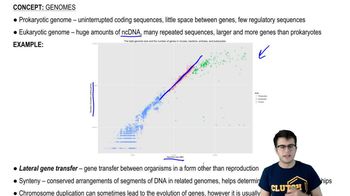
Genomes and Genome Evolution

C-value Paradox

The C-value paradox describes the lack of correlation between genome size and organismal complexity. Despite expectations, more complex organisms do not always have larger genomes. This paradox is due to non-coding DNA and repetitive sequences that contribute to genome size without increasing complexity, making predictions about genome size challenging.
Recommended video:
06:58
C. Calculating Allele Frequency from Phenotype Frequency

Amoeba Genome Size

Amoebas, despite being single-celled organisms, can have extremely large genomes, sometimes exceeding those of humans. This is due to the presence of large amounts of non-coding DNA and repetitive sequences. Therefore, predicting the genome size of an amoeba based on other single-celled organisms like yeast is unreliable, as amoebas can have much larger genomes.
Recommended video:
Guided course
05:30
Genomes and Genome Evolution