Pearson+ LogoPearson+ Logo
Ch. 28 - Green Algae and Land Plants
Freeman - Biological Science 8th Edition
Freeman8th EditionBiological ScienceISBN: 9780138276263Not the one you use?Change textbook
Chapter 28, Problem 2

The appearance of cuticle and stomata correlated with what event in the evolution of green plants?
a. The first upright growth forms
b. The first woody tissues
c. Growth on land
d. The evolution of the first water-conducting tissues

Verified step by step guidance
1
Understand the role of the cuticle and stomata in plants: The cuticle is a waxy layer that covers the surfaces of leaves and stems, helping to prevent water loss. Stomata are small openings on the surface of leaves that allow for gas exchange, crucial for photosynthesis.
Consider the environmental challenges plants faced when moving from aquatic to terrestrial environments: On land, plants needed to prevent desiccation (drying out) and manage gas exchange efficiently.
Recognize that the cuticle and stomata are adaptations to terrestrial life: These structures help plants conserve water while still allowing for the necessary exchange of gases (carbon dioxide and oxygen) for photosynthesis.
Identify the evolutionary event associated with these adaptations: The development of the cuticle and stomata is closely linked to the colonization of land by plants, as these adaptations were essential for survival outside of an aquatic environment.
Conclude that the appearance of cuticle and stomata is correlated with the growth on land, as these features were critical for plants to thrive in terrestrial habitats.

Verified video answer for a similar problem:

This video solution was recommended by our tutors as helpful for the problem above.
Video duration:
1m
Was this helpful?

Key Concepts

Here are the essential concepts you must grasp in order to answer the question correctly.

Cuticle

The cuticle is a waxy, protective layer covering the epidermis of plants, primarily found in terrestrial plants. It serves to minimize water loss by evaporation and provides a barrier against pathogens. The development of the cuticle was crucial for plants to adapt to terrestrial environments, where water conservation is vital.
Recommended video:
Guided course
08:59
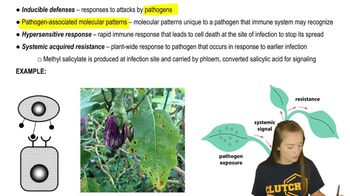
Pathogen Defenses

Stomata

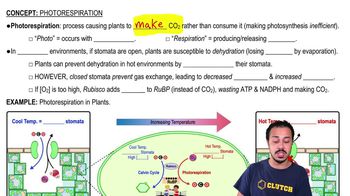
Stomata are small openings on the surfaces of leaves and stems that facilitate gas exchange. They allow plants to take in carbon dioxide for photosynthesis and release oxygen, while also regulating water vapor loss. The evolution of stomata was essential for plants to thrive on land, balancing the need for gas exchange with water conservation.
Recommended video:
Guided course
14:32
Photorespiration

Growth on Land

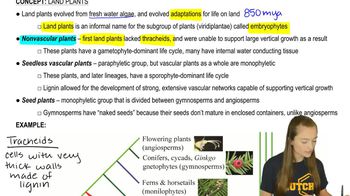
The transition of plants from aquatic to terrestrial environments marked a significant evolutionary event. This shift required adaptations like the cuticle and stomata to manage water retention and gas exchange. Growth on land allowed plants to exploit new ecological niches, leading to increased biodiversity and complexity in plant forms.
Recommended video: