
Pearson+ LogoPearson+ Logo
Ch. 31 - Protostome Animals
Freeman - Biological Science 8th Edition
Freeman8th EditionBiological ScienceISBN: 9780138276263Not the one you use?Change textbook
Chapter 31, Problem 15e

A team of 102 scientists spent a year surveying a small area of the San Lorenzo rain forest in Panama to count the number of species of arthropods living there. After collecting 129,494 specimens—using nets, traps, shovels, tree-climbing harnesses, helium balloons, and other creative gear—it took the team eight years to sort and identify the arthropods. By comparing the number of arthropod species that were common among the 12 plots sampled, the researchers estimated that the total number of arthropods in the whole San Lorenzo forest is 25,000 species.
To come up with this estimate, what's one assumption the researchers had to make about the forest?

Verified step by step guidance
1
The researchers had to assume that the 12 plots sampled were representative of the entire San Lorenzo rain forest. This means that the diversity and distribution of arthropod species in these plots are similar to those in the rest of the forest.
They likely assumed that the sampling methods used (nets, traps, shovels, etc.) were effective at capturing a wide variety of arthropod species and did not disproportionately favor certain species over others.
The researchers would have assumed that the arthropod populations were relatively stable over the time of the study, meaning that no significant changes in species diversity or abundance occurred during the sampling period.
They assumed that the identification and classification of arthropod species were accurate and consistent, ensuring that species were not misidentified or counted multiple times.
Finally, the researchers assumed that the mathematical or statistical model used to extrapolate the total number of species from the sampled plots was valid and appropriately accounted for any potential biases or errors in the data.

Verified video answer for a similar problem:

This video solution was recommended by our tutors as helpful for the problem above.
Video duration:
2m
Was this helpful?

Key Concepts

Here are the essential concepts you must grasp in order to answer the question correctly.

Biodiversity Estimation

Biodiversity estimation involves assessing the variety of species within a given ecosystem. Researchers often use sampling methods to infer the total number of species present based on the species observed in smaller plots. This process relies on statistical models and assumptions about species distribution and abundance, which can significantly influence the accuracy of the estimates.
Recommended video:
Guided course
03:56
Conservation Biology and Biodiversity

Sampling Assumptions

When conducting ecological surveys, researchers must make assumptions about the representativeness of their samples. One common assumption is that the sampled plots accurately reflect the diversity and distribution of species throughout the entire area. This means that the species found in the sampled plots are assumed to be similar to those in unsampled areas, which is crucial for extrapolating total species numbers.
Recommended video:
Guided course
02:10
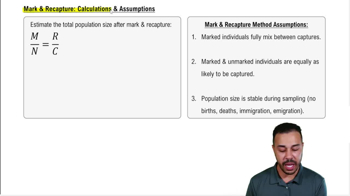
Mark & Recapture: Calculations & Assumptions

Species Distribution

Species distribution refers to how species are spread across different habitats and geographical areas. Understanding species distribution patterns is essential for estimating total biodiversity, as it helps researchers predict where species might be found based on environmental factors. Assumptions about uniformity or variability in species distribution can greatly affect biodiversity estimates derived from limited sampling.
Recommended video:
Guided course
01:12
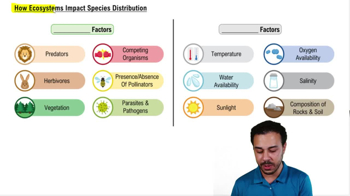
How Ecosystems Impact Species Distribution
Related Practice
Textbook Question

A team of 102 scientists spent a year surveying a small area of the San Lorenzo rain forest in Panama to count the number of species of arthropods living there. After collecting 129,494 specimens—using nets, traps, shovels, tree-climbing harnesses, helium balloons, and other creative gear—it took the team eight years to sort and identify the arthropods. Rather than measuring the entire 6000-hectare (ha) forest, the researchers sampled arthropod diversity by intensively collecting as many arthropods as they could in 12 plots that measured 20 m × 20m square. If 1 ha=10,000 m², how many hectares of forest did they sample in all?

a. 20 m×20 m×12=4800 ha

b. 4800 m²×10,000 m²/1 ha=48,000,000 ha

c. 20 m×20 m=400 ha

d. 4800 m² x ha/10,000 m² = 0.48 ha

568
views
Textbook Question

A team of 102 scientists spent a year surveying a small area of the San Lorenzo rain forest in Panama to count the number of species of arthropods living there. After collecting 129,494 specimens—using nets, traps, shovels, tree-climbing harnesses, helium balloons, and other creative gear—it took the team eight years to sort and identify the arthropods. The graph below shows some of the data for the major arthropod groups collected. Notice that the scale on the y-axis is logarithmic to make both small and large numbers legible on the same graph. For example, there are about 400 species of spiders but only 40 species of bees.

About how many arthropods were found in total?

About what percentage of these were beetles?

660
views
Textbook Question

A team of 102 scientists spent a year surveying a small area of the San Lorenzo rain forest in Panama to count the number of species of arthropods living there. After collecting 129,494 specimens—using nets, traps, shovels, tree-climbing harnesses, helium balloons, and other creative gear—it took the team eight years to sort and identify the arthropods. A team of 102 scientists spent a year surveying a small area of the San Lorenzo rain forest in Panama to count the number of species of arthropods living there. After collecting 129,494 specimens—using nets, traps, shovels, tree-climbing harnesses, helium balloons, and other creative gear—it took the team eight years to sort and identify the arthropods. Use the data in the graph to analyze the following statements.

Select True or False for each statement, then correct any false statements to make them true.

T/FAll taxa shown in the graph are insects.

T/FAll taxa shown in the graph have segmented bodies and limbs.

T/FAll taxa shown in the graph are terrestrial.

T/FIf the researchers had sampled for mollusks, they probably would have found almost as many species as they did for arthropods.

769
views
Textbook Question

A team of 102 scientists spent a year surveying a small area of the San Lorenzo rain forest in Panama to count the number of species of arthropods living there. After collecting 129,494 specimens—using nets, traps, shovels, tree-climbing harnesses, helium balloons, and other creative gear—it took the team eight years to sort and identify the arthropods. The researchers observed a strong correlation between the number of arthropod species and the number of plant species in the San Lorenzo forest.

Pose an evolutionary hypothesis to explain this correlation.

853
views