
Pearson+ LogoPearson+ Logo
Ch. 36 - Plant Nutrition
Freeman - Biological Science 8th Edition
Freeman8th EditionBiological ScienceISBN: 9780138276263Not the one you use?Change textbook
Chapter 36, Problem 3

Why are proton pumps in root-hair plasma membranes important?
a. They pump protons into cells, generating a membrane potential (voltage).
b. They allow toxins to be concentrated in vacuoles, so the toxins do not poison enzymes in the cytoplasm.
c. They set up an electrochemical gradient that makes it possible for roots to absorb cations and anions.
d. They set up the membrane voltage required for action potentials to occur.

Verified step by step guidance
1
Understand the role of proton pumps: Proton pumps in root-hair plasma membranes are responsible for moving protons (H+ ions) across the membrane, which is crucial for various cellular processes.
Recognize the creation of an electrochemical gradient: By pumping protons out of the cell, these pumps create an electrochemical gradient. This gradient is essential for the transport of nutrients and ions.
Consider the absorption of ions: The electrochemical gradient established by proton pumps facilitates the absorption of cations (positively charged ions) and anions (negatively charged ions) into the root cells.
Evaluate the options: Option c states that proton pumps set up an electrochemical gradient that makes it possible for roots to absorb cations and anions, which aligns with the function of proton pumps.
Conclude the importance: The primary importance of proton pumps in root-hair plasma membranes is their role in setting up the electrochemical gradient necessary for nutrient and ion absorption, supporting option c.

Verified video answer for a similar problem:

This video solution was recommended by our tutors as helpful for the problem above.
Video duration:
32s
Was this helpful?

Key Concepts

Here are the essential concepts you must grasp in order to answer the question correctly.

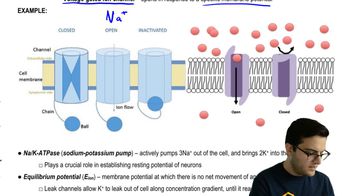
Proton Pumps

Proton pumps are integral membrane proteins that actively transport protons (H+) across biological membranes, using energy derived from ATP. In root-hair cells, these pumps create a proton gradient by moving protons out of the cell, which is crucial for various cellular processes, including nutrient uptake and maintaining pH balance.
Recommended video:
Guided course
08:38
Ion Channels and Pumps

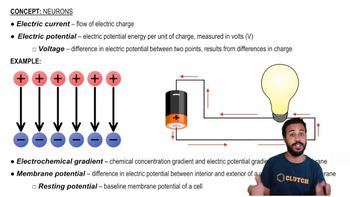
Membrane Potential

Membrane potential refers to the voltage difference across a cell's plasma membrane, resulting from the distribution of ions. Proton pumps contribute to this potential by exporting protons, leading to a charge difference that is essential for the transport of ions and nutrients into the cell, influencing cellular activities and signaling.
Recommended video:
Guided course
10:31
Membrane Potential

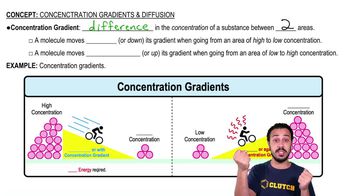
Electrochemical Gradient

An electrochemical gradient is the combined effect of an ion's concentration gradient and the electrical potential across a membrane. Proton pumps establish this gradient, enabling the passive movement of ions like cations and anions into root cells, which is vital for nutrient absorption and overall plant health.
Recommended video:
Guided course
04:51
Concentration Gradients and Diffusion
Related Practice
Textbook Question

Consider the following statements regarding limiting nutrients. Select True or False for each statement.

T/F Nitrogen (N), phosphorus (P), and potassium (K) are common examples.

T/F Their presence limits the availability of micronutrients.

T/F Their availability tends to limit plant growth.

T/F Certain macronutrients and micronutrients can be considered limiting nutrients.

1060
views
Textbook Question

Where does most nutrient uptake occur in roots?

a. At the root cap, where root tissue first encounters soil away from the zone of nutrient depletion

b. At the Casparian strip, where ions must enter the symplast before entering xylem cells

c. In the symplastic and apoplastic pathways

d. In root hairs, in the zone of maturation

1302
views
Textbook Question

Why is the presence of clay particles important in soil?

a. They provide macronutrients—particularly nitrogen, phosphorus, and potassium.

b. They bind metal ions, which would be toxic if absorbed by plants.

c. They allow water to percolate through the soil, making oxygen-rich air pockets available. d. The negative charges on clay bind to positively charged ions and prevent them from being leached out of the soil.

1171
views
Textbook Question

Suppose that certain root cells have an overall charge that is more negative than normal. What impact would this likely have on the uptake of anions such as NO3⁻?

a. Anions would be less likely to enter roots.

b. Anions would be more likely to enter roots.

c. This would have no impact on the ability of anions to enter roots.

d. This would make anions and cations equally likely to enter roots.

1046
views
Textbook Question

In a semester-long experiment tracking growth in plants, your lab partner—who often skips class—carefully records the mass of water added to a potted plant with the expectation that this addition will be fully accounted for in the mass gained by the plant. Is your lab partner right or wrong? Explain.

795
views