
Pearson+ LogoPearson+ Logo
Ch. 37 - Plant Sensory Systems, Signals, and Responses
Freeman - Biological Science 8th Edition
Freeman8th EditionBiological ScienceISBN: 9780138276263Not the one you use?Change textbook
Chapter 37, Problem 15e

Leaflets of Mimosa pudica (common names: sensitive plant, touch-me-not) have a remarkable ability to close up in response to being touched or physically moved.
How fast can the leaflets close? How does this occur?
And more importantly, what benefit could this unusual response provide to the plant? Researchers have hypothesized that rapid leaf movements in Mimosa serve as a defense mechanism (e.g., closing leaflets may deter plant-eating insects).
Propose an experiment to test this hypothesis.

Verified step by step guidance
1
Step 1: Define the hypothesis clearly. In this case, the hypothesis is that the rapid leaf movements of Mimosa pudica serve as a defense mechanism to deter plant-eating insects.
Step 2: Design the experiment. You will need two groups of Mimosa pudica plants: a control group where the plants are not exposed to any potential threats, and an experimental group where the plants are exposed to plant-eating insects.
Step 3: Determine the variables. The independent variable is the presence of plant-eating insects, and the dependent variable is the rate or extent of leaflet closure. Control variables could include environmental conditions like light, temperature, and humidity.
Step 4: Conduct the experiment. Introduce plant-eating insects to the experimental group and observe the response of the leaflets. Record the time it takes for the leaflets to close and compare it to the control group.
Step 5: Analyze the results. If the leaflets in the experimental group close significantly faster or more completely than those in the control group, it would support the hypothesis that the leaf movements serve as a defense mechanism. Consider statistical analysis to determine the significance of the results.

Verified video answer for a similar problem:

This video solution was recommended by our tutors as helpful for the problem above.
Video duration:
1m
Was this helpful?

Key Concepts

Here are the essential concepts you must grasp in order to answer the question correctly.

Thigmonasty

Thigmonasty refers to the non-directional movement of plant parts in response to touch or physical stimuli. In Mimosa pudica, this rapid movement is facilitated by changes in turgor pressure within the pulvini, specialized cells at the base of the leaflets. When stimulated, these cells lose water, causing the leaflets to fold inward quickly.

Turgor Pressure

Turgor pressure is the force exerted by fluid inside the plant cells against the cell wall. It is crucial for maintaining plant rigidity and is involved in various plant movements. In Mimosa pudica, changes in turgor pressure within the pulvini cells lead to the rapid closing of leaflets, a response triggered by external stimuli like touch.
Recommended video:
Guided course
11:58
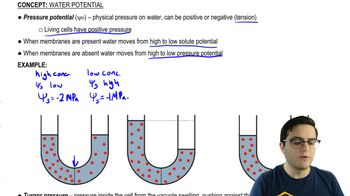
Pressure Potential and Turgidity

Plant Defense Mechanisms

Plants have evolved various defense mechanisms to protect against herbivores and environmental stress. In Mimosa pudica, the rapid closing of leaflets may serve as a deterrent to herbivores, making the plant less appealing or accessible. This movement can also reduce water loss and protect against physical damage, contributing to the plant's survival.
Recommended video:
Guided course
08:59
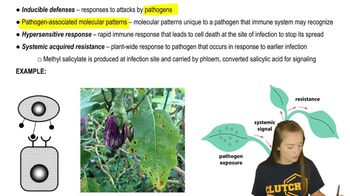
Pathogen Defenses
Related Practice
Textbook Question

Leaflets of Mimosa pudica (common names: sensitive plant, touch-me-not) have a remarkable ability to close up in response to being touched or physically moved.

How fast can the leaflets close?

How does this occur?

And more importantly, what benefit could this unusual response provide to the plant?

Which of the following terms best describes the leaflet movement?

a. Thigmonastic movements

b. Thigmotropism

c. Thigmomorphogenesis

d. Apical dominance

863
views
Textbook Question

Leaflets of Mimosa pudica (common names: sensitive plant, touch-me-not) have a remarkable ability to close up in response to being touched or physically moved.

How fast can the leaflets close? How does this occur?

And more importantly, what benefit could this unusual response provide to the plant?

The mechanism of leaflet closure is similar to what happens during the shrinking of guard cells and closing of stomata (see Figure 37.22). When in the open position, special cells on the upper surface of Mimosa leaflets are filled with water and are under pressure.

Explain how osmosis and flow of ions into and out of these special cells may be involved in leaflet closure and reopening.

839
views
Textbook Question

Leaflets of Mimosa pudica (common names: sensitive plant, touch-me-not) have a remarkable ability to close up in response to being touched or physically moved.

How fast can the leaflets close?

How does this occur?

And more importantly, what benefit could this unusual response provide to the plant?

If just the leaflets located toward the end of a leaf are touched, the adjacent leaflets close in fairly rapid succession until all leaflets on a leaf close up.

Explain how electrical signaling may be involved in this response.

794
views
Textbook Question

Leaflets of Mimosa pudica (common names: sensitive plant, touch-me-not) have a remarkable ability to close up in response to being touched or physically moved.

How fast can the leaflets close?

How does this occur?

And more importantly, what benefit could this unusual response provide to the plant?

Mimosa leaflets also close on their own at dusk and reopen at dawn (this cycle develops as a circadian rhythm).

What receptor molecule mentioned in this chapter is likely involved in regulating this process?

745
views