
Pearson+ LogoPearson+ Logo
Ch. 37 - Plant Sensory Systems, Signals, and Responses
Freeman - Biological Science 8th Edition
Freeman8th EditionBiological ScienceISBN: 9780138276263Not the one you use?Change textbook
Chapter 37, Problem 2

Which of the following statements about phytochrome is not correct?
a. It is photoreversible.
b. Its function was understood long before the protein itself was isolated.
c. The Pfr form activates the responses to red light.
d. It is involved in guard-cell opening.

Verified step by step guidance
1
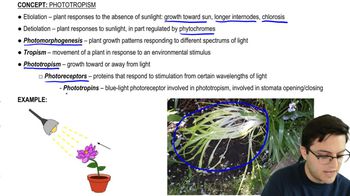
Understand the role of phytochrome: Phytochrome is a photoreceptor in plants that is sensitive to light in the red and far-red region of the electromagnetic spectrum. It plays a crucial role in regulating various plant developmental processes.
Review the concept of photoreversibility: Phytochrome exists in two interconvertible forms, Pr and Pfr. The Pr form absorbs red light and converts to Pfr, while the Pfr form absorbs far-red light and converts back to Pr. This photoreversibility is a key feature of phytochrome.
Examine the historical context: The function of phytochrome in plant development, such as seed germination and flowering, was studied and understood before the actual protein was isolated and characterized.
Analyze the role of Pfr: The Pfr form of phytochrome is the active form that triggers various physiological responses in plants, such as seed germination and flowering, in response to red light.
Consider the involvement in guard-cell opening: Phytochrome is primarily known for its role in processes like seed germination and flowering, but it is not typically associated with the opening of guard cells, which is more directly influenced by blue light receptors.

Verified video answer for a similar problem:

This video solution was recommended by our tutors as helpful for the problem above.
Video duration:
23s
Was this helpful?

Key Concepts

Here are the essential concepts you must grasp in order to answer the question correctly.

Phytochrome

Phytochrome is a photoreceptor in plants that detects light and is crucial for regulating various developmental processes. It exists in two forms, Pr and Pfr, which are interconvertible depending on the light conditions. This photoreversibility allows plants to respond to changes in light quality, influencing processes like seed germination and flowering.
Recommended video:
Guided course
12:53
Photomorphogenesis

Photoreversibility

Photoreversibility refers to the ability of phytochrome to switch between two forms, Pr and Pfr, in response to red and far-red light. This reversible transformation enables plants to sense and adapt to their light environment, playing a critical role in processes such as photoperiodism and shade avoidance.
Recommended video:
Guided course
12:53
Photomorphogenesis

Guard-cell Function

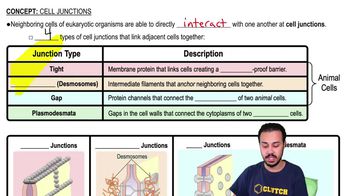
Guard cells are specialized cells in the epidermis of plant leaves that regulate the opening and closing of stomata, controlling gas exchange and water loss. While phytochrome influences many light-dependent processes, its direct involvement in guard-cell opening is not well-established, making this statement potentially incorrect in the context of phytochrome's known functions.
Recommended video:
Guided course
05:33
Cell Junctions
Related Practice
Textbook Question

Evaluate the following assertions about phototropism. Select True or False for each statement.

T/F Cells on the illuminated side of a stem elongate more than cells on the shaded side.

T/F Phototropism is triggered by blue light.

T/F Phototropins play a significant role in phototropism.

T/F The bending of the plant is due to cell elongation in response to auxin.

827
views
Textbook Question

Which of the following statements about hormones is correct?

a. They tend to be large molecules.

b. They exert their effects only on the same cells that produce them.

c. They can exert strong effects only when they are present in high concentrations.

d. They trigger a response by binding to target-cell receptors.

670
views
Textbook Question

What evidence suggests that ABA from roots can signal guard cells to close?

a. If roots are given sufficient water, guard cells close anyway.

b. If roots are dry, guard cells begin to close—even though leaves may not be experiencing water stress.

c. Applying ABA to guard cells directly causes them to close.

d. If roots are dry, the ABA concentration in leaf cells drops dramatically.

660
views
Textbook Question

Why was it logical to predict that amyloplasts function as statoliths?

a. They are dense and settle to the bottom of gravity-sensing cells.

b. They are present only in gravity-sensing cells.

c. They make a direct physical connection with membrane proteins that have been shown to be gravity-receptor molecules.

d. Their density changes in response to gravity.

657
views