
Ch. 37 - Plant Sensory Systems, Signals, and Responses
Freeman - Biological Science 8th Edition
Freeman8th EditionBiological ScienceISBN: 9780138276263Not the one you use?Change textbook
Chapter 37, Problem 3

Which of the following statements about hormones is correct?
a. They tend to be large molecules.
b. They exert their effects only on the same cells that produce them.
c. They can exert strong effects only when they are present in high concentrations.
d. They trigger a response by binding to target-cell receptors.

Verified step by step guidance
1
Step 1: Understand what hormones are. Hormones are chemical messengers produced by glands in the endocrine system. They travel through the bloodstream to tissues and organs, affecting various physiological processes.
Step 2: Analyze option a. Hormones can be large molecules, such as proteins, but they can also be small molecules, like steroids. Therefore, this statement is not universally correct.
Step 3: Analyze option b. Hormones typically exert their effects on cells other than those that produce them. They travel through the bloodstream to reach target cells, so this statement is incorrect.
Step 4: Analyze option c. Hormones can exert strong effects even at low concentrations due to their high specificity and affinity for their receptors. Therefore, this statement is incorrect.
Step 5: Analyze option d. Hormones trigger responses by binding to specific receptors on target cells, initiating a cascade of cellular events. This statement is correct as it describes the fundamental mechanism of hormone action.

Verified video answer for a similar problem:

This video solution was recommended by our tutors as helpful for the problem above.
Video duration:
28s
Was this helpful?

Key Concepts

Here are the essential concepts you must grasp in order to answer the question correctly.

Hormone Structure

Hormones can vary in size and structure, ranging from small molecules like amino acids and steroids to larger peptide and protein hormones. Their size and structure influence their solubility and the mechanism by which they travel through the bloodstream to reach target cells.
Recommended video:
Guided course
08:18
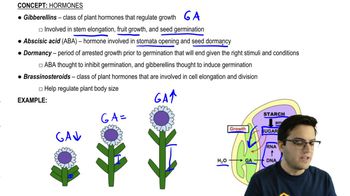
Plant Hormones and Senescence

Hormone Target Specificity

Hormones exert their effects on specific target cells that possess receptors for them, rather than affecting only the cells that produce them. This specificity is crucial for the regulation of physiological processes, as hormones can travel through the bloodstream to reach distant target cells.
Recommended video:
Guided course
08:18
Plant Hormones and Senescence

Hormone Concentration and Effect

Hormones can exert significant effects even at low concentrations due to the amplification of their signal within target cells. This is achieved through mechanisms such as signal transduction pathways, where binding to receptors triggers a cascade of intracellular events, leading to a physiological response.
Recommended video:
Guided course
04:51
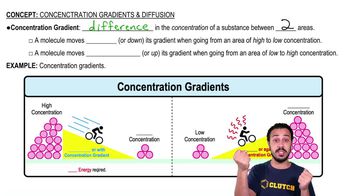
Concentration Gradients and Diffusion
Related Practice
Textbook Question

Evaluate the following assertions about phototropism. Select True or False for each statement.

T/F Cells on the illuminated side of a stem elongate more than cells on the shaded side.

T/F Phototropism is triggered by blue light.

T/F Phototropins play a significant role in phototropism.

T/F The bending of the plant is due to cell elongation in response to auxin.

802
views
Textbook Question

Which of the following statements about phytochrome is not correct?

a. It is photoreversible.

b. Its function was understood long before the protein itself was isolated.

c. The Pfr form activates the responses to red light.

d. It is involved in guard-cell opening.

853
views
Textbook Question

What evidence suggests that ABA from roots can signal guard cells to close?

a. If roots are given sufficient water, guard cells close anyway.

b. If roots are dry, guard cells begin to close—even though leaves may not be experiencing water stress.

c. Applying ABA to guard cells directly causes them to close.

d. If roots are dry, the ABA concentration in leaf cells drops dramatically.

645
views
Textbook Question

Why was it logical to predict that amyloplasts function as statoliths?

a. They are dense and settle to the bottom of gravity-sensing cells.

b. They are present only in gravity-sensing cells.

c. They make a direct physical connection with membrane proteins that have been shown to be gravity-receptor molecules.

d. Their density changes in response to gravity.

648
views
Textbook Question

Phytochromes can be considered 'shade detectors,' while phototropins such as PHOT1 can be considered 'sunlight detectors.' Explain why these characterizations are valid.

700
views