
Textbook Question
Explain why most endotherms are homeothermic and most ectotherms are poikilothermic.
1030
views

 Verified step by step guidance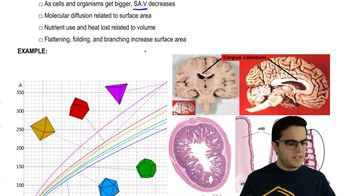
 07:47
07:47 07:47
07:47 03:00
03:00Explain why most endotherms are homeothermic and most ectotherms are poikilothermic.
Explain why it would be impossible for a gorilla the size of King Kong to have fur. (Your answer should explain how the surface area to volume ratio of a normal-sized gorilla would compare to Kong's; relate this to the role of surface area and volume in heat generation and heat transfer, and consider the function of fur.)
Consider three spheres with radii of 1 cm, 5 cm, and 10 cm.
Calculate the surface area and the volume of each sphere, and plot the results on a graph with radius on the x-axis and surface area and volume on the y-axis. (Surface area of a sphere = 4πr2; volume of a sphere = (4/3)πr3.)
Explain how the graph shows the relationship between size and surface area to volume ratio.
For each of the following, explain how structure relates to function:
absorptive sections of the digestive tract;
capillaries;
beaks of Galápagos finches;
fish gills.
The dinosaur Apatosaurus (Brontosaurus) is one of the largest terrestrial animals that ever lived—over 20 m in length and weighing over 20 metric tons. Is it more likely that Apatosaurus was homeothermic or poikilothermic? Explain.
The metabolic rate of a frog in summer (at 35°C) is about eight times higher than in winter (at 5°C). Compare and contrast the frog's ability to move, exchange gases, and digest food at the two temperatures.
During which season will the frog require more food energy, and why?