

Pearson+ LogoPearson+ Logo
Ch. 6 - Lipids, Membranes, and the First Cells
Freeman - Biological Science 8th Edition
Freeman8th EditionBiological ScienceISBN: 9780138276263Not the one you use?Change textbook
Chapter 6, Problem 9

In an experiment, you create two groups of liposomes in a solution containing 0.1 M NaCl—one made from red blood cell membranes and the other from frog egg cell membranes. When the liposomes are placed in water, those with red blood cell membranes burst more rapidly than those made from egg membranes. What could explain these results? Select True or False for each of the following statements.
a. T/F The red blood cell liposomes are more hypertonic relative to water than the frog egg liposomes.
b. T/F The red blood cell liposomes are more hypotonic relative to water than the frog egg liposomes.
c. T/F The red blood cell liposomes contain more aquaporins than the frog egg liposomes.
d. T/F The frog egg liposomes contain ion channels, which are not present in the red blood cell liposomes.

Verified step by step guidance
1
Step 1: Understand the concept of tonicity. Tonicity refers to the relative concentration of solutes in two solutions separated by a semipermeable membrane. A hypertonic solution has a higher concentration of solutes compared to another solution, while a hypotonic solution has a lower concentration.
Step 2: Analyze statement a. Consider whether the red blood cell liposomes are more hypertonic relative to water than the frog egg liposomes. If the red blood cell liposomes burst more rapidly, it suggests they might be more hypertonic, causing water to rush in and burst them.
Step 3: Analyze statement b. Consider whether the red blood cell liposomes are more hypotonic relative to water than the frog egg liposomes. If they were hypotonic, water would move out, which is less likely to cause bursting.
Step 4: Analyze statement c. Consider the role of aquaporins, which are water channels that facilitate the rapid movement of water across cell membranes. If red blood cell liposomes contain more aquaporins, it could explain the rapid influx of water and bursting.
Step 5: Analyze statement d. Consider the presence of ion channels in frog egg liposomes. Ion channels allow ions to pass through the membrane, potentially affecting osmotic balance differently than aquaporins. If frog egg liposomes have ion channels, it might explain their slower bursting rate compared to red blood cell liposomes.

Verified video answer for a similar problem:

This video solution was recommended by our tutors as helpful for the problem above.
Video duration:
2m
Was this helpful?

Key Concepts

Here are the essential concepts you must grasp in order to answer the question correctly.

Osmosis and Tonicity

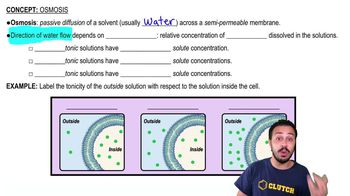
Osmosis is the movement of water across a semipermeable membrane from a region of lower solute concentration to a region of higher solute concentration. Tonicity refers to the relative concentration of solutes outside the cell compared to inside, affecting water movement. A hypertonic solution has a higher solute concentration outside, causing water to leave the cell, while a hypotonic solution has a lower solute concentration outside, causing water to enter the cell.
Recommended video:

Membrane Composition and Permeability

Cell membranes are composed of a lipid bilayer with embedded proteins, which determine the membrane's permeability to various substances. The presence of specific proteins, such as aquaporins, can increase water permeability. Differences in membrane composition between red blood cells and frog egg cells can affect how quickly water moves across the membrane, influencing the rate at which liposomes burst in hypotonic conditions.
Recommended video:
Guided course
02:47
Introduction to Membrane Transport

Aquaporins and Ion Channels

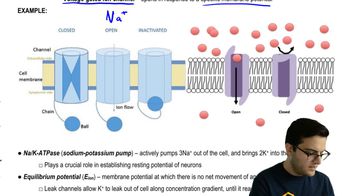
Aquaporins are membrane proteins that facilitate rapid water transport across cell membranes, significantly affecting osmosis. Ion channels, on the other hand, allow the passage of ions and can influence the cell's osmotic balance. The presence or absence of these proteins in liposomes can explain differences in their behavior when placed in water, as they alter the rate of water influx or efflux, impacting the stability of the liposomes.
Recommended video:
Guided course
08:38
Ion Channels and Pumps