Ch. 8 - Sequences, Induction, and Probability
Blitzer - College Algebra 8th Edition
Blitzer8th EditionCollege AlgebraISBN: 9780136970514Not the one you use?Change textbook
Chapter 9, Problem 22

In Exercises 19–22, the general term of a sequence is given and involves a factorial. Write the first four terms of each sequence. an=−2(n−1)!

Verified step by step guidance
1
Identify the general term of the sequence given by the formula \(a_n = -2 (n - 1)!\), where \(n\) is the term number and \((n - 1)!\) denotes the factorial of \((n - 1)\).
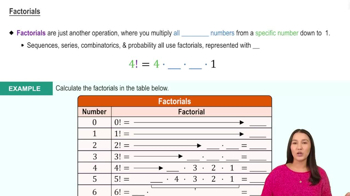
Recall that the factorial of a non-negative integer \(k\), written as \(k!\), is the product of all positive integers from 1 up to \(k\). For example, \(0! = 1\), \(1! = 1\), \(2! = 2 \times 1 = 2\), \(3! = 3 \times 2 \times 1 = 6\), and so on.
Calculate the first four terms by substituting \(n = 1, 2, 3, 4\) into the formula \(a_n = -2 (n - 1)!\):
For each \(n\), compute \((n - 1)!\) and then multiply by \(-2\) to find \(a_n\):
Write down the values of \(a_1, a_2, a_3,\) and \(a_4\) as the first four terms of the sequence.

Verified video answer for a similar problem:

This video solution was recommended by our tutors as helpful for the problem above.
Video duration:
6m
Was this helpful?

Key Concepts

Here are the essential concepts you must grasp in order to answer the question correctly.

Factorial Notation

The factorial of a non-negative integer n, denoted n!, is the product of all positive integers from 1 to n. For example, 4! = 4 × 3 × 2 × 1 = 24. By definition, 0! = 1. Factorials grow rapidly and are commonly used in sequences and combinatorics.
Recommended video:
5:22
Factorials

General Term of a Sequence

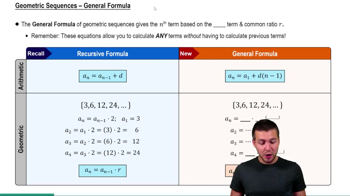
The general term a_n of a sequence defines the nth term as a function of n. It allows you to find any term without listing all previous terms. For example, a_n = -2(n-1)! means each term depends on the factorial of (n-1), scaled by -2.
Recommended video:
Guided course
4:45
Geometric Sequences - General Formula

Evaluating Sequence Terms

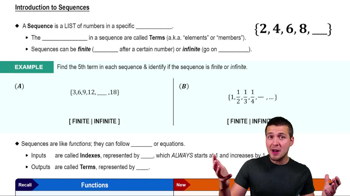
To find specific terms of a sequence, substitute the term number n into the general term formula. For a_n = -2(n-1)!, calculate (n-1)! first, then multiply by -2. This process helps write out the first few terms explicitly.
Recommended video:
Guided course
8:22
Introduction to Sequences