
Ch.6 - Electronic Structure of Atoms
Brown - Chemistry: The Central Science 14th Edition
Brown14th EditionChemistry: The Central ScienceISBN: 9780134414232Not the one you use?Change textbook
Chapter 6, Problem 94a

Bohr's model can be used for hydrogen-like ions—ions that have only one electron, such as He+ and Li2+. (a) Why is the Bohr model applicable to He+ ions but not to neutral He atoms?

Verified step by step guidance
1
Understand the Bohr model: The Bohr model is specifically designed for systems where a single electron orbits a nucleus. It simplifies the electron-nucleus interaction by considering only one electron moving in a fixed orbit around the nucleus.
Recognize the electron configuration of He+ and neutral He: Helium (He) in its neutral state has two electrons. When it loses one electron, becoming He+, it has only one electron remaining.
Consider electron-electron interaction: In neutral helium, the presence of two electrons means that electron-electron repulsion must be considered, which complicates the system beyond what the Bohr model can accurately handle.
Apply the Bohr model to He+: Since He+ has only one electron, the system is simplified to a single electron orbiting the nucleus, similar to the hydrogen atom. This fits the conditions under which the Bohr model provides a good approximation.
Conclude why Bohr model is not applicable to neutral He: The Bohr model does not account for interactions between multiple electrons, which is necessary for accurately describing the behavior of neutral helium with its two electrons.

Verified video answer for a similar problem:

This video solution was recommended by our tutors as helpful for the problem above.
Video duration:
2m

Key Concepts

Here are the essential concepts you must grasp in order to answer the question correctly.

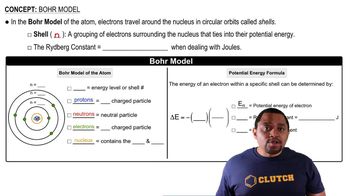
Bohr's Model of the Atom

Bohr's model describes the atom as a small, positively charged nucleus surrounded by electrons that travel in circular orbits. It quantizes the angular momentum of electrons, allowing only certain stable orbits. This model is particularly effective for hydrogen-like ions, where a single electron is influenced by the nucleus's charge.
Recommended video:
Guided course
02:43
Bohr Model of the Atom

Hydrogen-like Ions

Hydrogen-like ions are ions that contain only one electron, similar to hydrogen. Examples include He<sup>+</sup> and Li<sup>2+</sup>. The simplicity of having a single electron allows for the application of Bohr's model, as the electron's behavior can be accurately predicted by the model's equations, unlike in multi-electron systems.
Recommended video:
Guided course
02:25
Hydrogen Isotopes

Electron-Electron Interactions

In neutral helium (He), there are two electrons that repel each other due to their negative charges. This electron-electron interaction complicates the energy levels and orbital shapes, making the Bohr model inadequate. The model does not account for these interactions, which are significant in multi-electron atoms, leading to deviations from the predictions made for hydrogen-like ions.
Recommended video:
Guided course
04:44
Electron Geometry