
Carbon dioxide, which is recognized as the major contributor to global warming as a “greenhouse gas,” is formed when fossil fuels are combusted, as in electrical power plants fueled by coal, oil, or natural gas. One potential way to reduce the amount of CO2 added to the atmosphere is to store it as a compressed gas in underground formations. Consider a 1000-megawatt coal-fired power plant that produces about 6⨉106 tons of CO2 per year. (b) If the CO2 is stored underground as a liquid at 10 C and 12.16 MPa and a density of 1.2 g/cm3, what volume does it possess?
Verified step by step guidanceKey Concepts
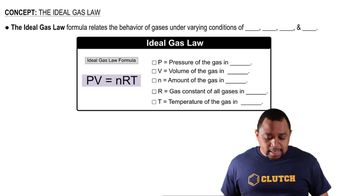
Ideal Gas Law
Density and Volume Relationship
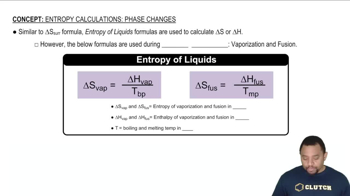
Phase Changes of Substances
Carbon dioxide, which is recognized as the major contributor to global warming as a 'greenhouse gas,' is formed when fossil fuels are combusted, as in electrical power plants fueled by coal, oil, or natural gas. One potential way to reduce the amount of CO2 added to the atmosphere is to store it as a compressed gas in underground formations. Consider a 1000-megawatt coal-fired power plant that produces about 6×10⁶ tons of CO2 per year. (a) Assuming ideal-gas behavior, 101.3 kPa, and 27 °C, calculate the volume of CO2 produced by this power plant.
A gas bubble with a volume of 1.0 mm3 originates at the bottom of a lake where the pressure is 3.0 atm. Calculate its volume when the bubble reaches the surface of the lake where the pressure is 730 torr, assuming that the temperature does not change.
Assume that a single cylinder of an automobile engine has a volume of 524 cm3. (a) If the cylinder is full of air at 74 C and 99.3 kPa, how many moles of O2 are present? (The mole fraction of O2 in dry air is 0.2095.) (b) How many grams of C8H18 could be combusted by this quantity of O2, assuming complete combustion with formation of CO2 and H2O?
