Ch.12 - Solids and Solid-State Materials
McMurry - Chemistry 8th Edition
McMurry8th EditionChemistryISBN: 9781292336145Not the one you use?Change textbook
Chapter 12, Problem 54

Silicon carbide, SiC, is a covalent network solid with a structuresimilar to that of diamond. Sketch a small portion ofthe SiC structure.

Verified step by step guidance
1
Step 1: Understand the structure of a covalent network solid. In a covalent network solid, atoms are bonded together in a continuous network. Each atom is covalently bonded to its nearest neighbors.
Step 2: Recall the structure of diamond. In diamond, each carbon atom is covalently bonded to four other carbon atoms in a tetrahedral arrangement.
Step 3: Apply this structure to silicon carbide (SiC). In SiC, each silicon (Si) atom is covalently bonded to four carbon (C) atoms, and each carbon atom is covalently bonded to four silicon atoms, also in a tetrahedral arrangement.
Step 4: Sketch the structure. Start by drawing a silicon atom, then draw four lines representing covalent bonds extending from it. At the end of each line, draw a carbon atom. Repeat this process for each carbon atom, drawing four silicon atoms around it. Continue this pattern to represent a small portion of the SiC structure.
Step 5: Remember that this is a simplified representation. In reality, the structure extends in three dimensions, with each atom covalently bonded to four others in a tetrahedral arrangement.

Key Concepts

Here are the essential concepts you must grasp in order to answer the question correctly.

Covalent Network Solids

Covalent network solids are materials where atoms are bonded together by a network of covalent bonds, forming a continuous structure. This results in high melting points, hardness, and electrical non-conductivity. Silicon carbide (SiC) exemplifies this type of solid, as its atoms are arranged in a three-dimensional lattice similar to that of diamond, contributing to its exceptional strength and thermal stability.
Recommended video:
Guided course
04:13
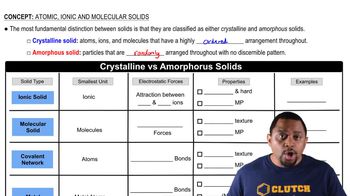
Crystalline vs Amorphous Solids

Crystal Structure

The crystal structure of a material refers to the orderly arrangement of atoms within the solid. In the case of silicon carbide, the structure can be visualized as a repeating pattern of silicon and carbon atoms, forming tetrahedral units. Understanding the crystal structure is essential for predicting the material's properties, such as its hardness and thermal conductivity.
Recommended video:
Guided course
01:42
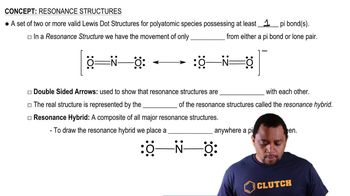
Resonance Structures

Tetrahedral Coordination

Tetrahedral coordination is a geometric arrangement where a central atom is surrounded by four other atoms at the corners of a tetrahedron. In SiC, silicon atoms are tetrahedrally coordinated with carbon atoms, leading to a strong and stable structure. This coordination is crucial for the material's mechanical properties and contributes to its high resistance to thermal and chemical degradation.
Recommended video:
Guided course
02:40
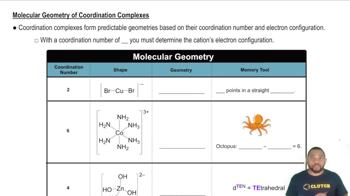
Molecular Geometry of Coordination Complexes
Related Practice
Textbook Question
Potassium metal crystallizes in a body-centered cubic structure. Draw one unit cell, and try to draw an electron-dot structure for bonding of the central K atom to its nearestneighbor K atoms. What is the problem?
741
views

Textbook Question
Cesium chloride crystallizes in a cubic unit cell with Cl- ions at the corners and a Cs+ ion in the center. Count the numbers of + and - charges, and show that the unit cell is electrically neutral.
947
views
Textbook Question
The melting point of sodium metal is 97.8 °C, and the melting point of sodium chloride is 801 °C. What can you infer about the relative strength of metallic and ionic bonding from these melting points?
2152
views
Textbook Question
If the edge length of an NaH unit cell is 488 pm, what is the length in picometers of an Na¬H bond? (See Problem 12.50.)
421
views
Textbook Question
If a protein can be induced to crystallize, its molecular structure can be determined by X-ray crystallography. Protein crystals, though solid, contain a large amount of water molecules along with the protein. The protein chicken egg-white lysozyme, for instance, crystallizes with a unit cell having angles of 90° and with edge lengths of 7.9 * 103 pm, 7.9 * 103 pm, and 3.8 * 103 pm. There are eight molecules in the unit cell. If the lysozyme molecule has a molecular weight of 1.44 * 104 and a density of 1.35 g>cm3, what percent of the unit cell is occupied by the protein?
557
views
Textbook Question
Carbon and oxygen combine to form the molecular compound CO2, while silicon and oxygen combine to form a covalent network solid with the formula unit SiO2. Explain the difference in bonding between the two group 4A elements and oxygen.
2164
views