
A 25.00-mL sample of an unknown H3PO4 solution is titrated with a 0.150 M NaOH solution. The equivalence point is reached when 22.97 mL of NaOH solution is added. What is the concentration of the unknown H3PO4 solution? The neutralization reaction is H3PO4(aq) + 3 NaOH(aq) → 3 H2O(l) + Na3PO4(aq)
Ch.5 - Introduction to Solutions and Aqueous Solutions

Chapter 5, Problem 64b,c
Write balanced complete ionic and net ionic equations for each acid–base reaction.
b. HCHO2(aq) + NaOH(aq) →
c. HC2H3O2(aq) + LiOH(aq) →
Verified step by step guidance1
Identify the reactants and products in the given acid-base reaction: HCHO_2 (formic acid) and NaOH (sodium hydroxide).
Write the balanced molecular equation for the reaction: HCHO_2(aq) + NaOH(aq) \(\rightarrow\) NaCHO_2(aq) + H_2O(l).
Break down all the strong electrolytes into their ions to write the complete ionic equation: HCHO_2(aq) + Na^+(aq) + OH^-(aq) \(\rightarrow\) Na^+(aq) + CHO_2^-(aq) + H_2O(l).
Identify the spectator ions, which are ions that appear on both sides of the complete ionic equation and do not participate in the reaction. In this case, Na^+ is the spectator ion.
Write the net ionic equation by removing the spectator ions: HCHO_2(aq) + OH^-(aq) \(\rightarrow\) CHO_2^-(aq) + H_2O(l).

Verified video answer for a similar problem:
This video solution was recommended by our tutors as helpful for the problem above.
Video duration:
3mWas this helpful?
Key Concepts
Here are the essential concepts you must grasp in order to answer the question correctly.
Acid-Base Reactions
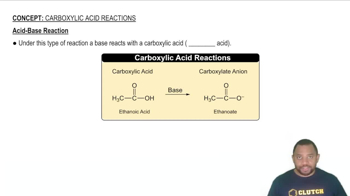
Acid-base reactions involve the transfer of protons (H+) between reactants. In this context, HCHO2 (formic acid) acts as an acid, donating a proton, while NaOH (sodium hydroxide) serves as a base, accepting the proton. Understanding the roles of acids and bases is crucial for writing balanced equations.
Recommended video:
Guided course
Acid-Base Reaction
Complete Ionic Equations
A complete ionic equation represents all the ions present in a solution during a reaction. It shows the reactants and products in their ionic forms, highlighting the dissociation of soluble ionic compounds. This step is essential for identifying the species involved in the reaction before simplifying to the net ionic equation.
Recommended video:
Guided course
Complete Ionic Equations
Net Ionic Equations
A net ionic equation focuses on the species that actually participate in the reaction, omitting spectator ions that do not change during the reaction. By removing these non-reactive ions, the net ionic equation provides a clearer picture of the chemical change occurring, which is particularly useful in acid-base reactions.
Recommended video:
Guided course
Net Ionic Equations
Related Practice
Textbook Question
Textbook Question
Write balanced molecular and net ionic equations for the reaction between hydrochloric acid and rubidium hydroxide.
1
views
Textbook Question
A 15.00-mL sample of an unknown HClO4 solution requires titration with 17.03 mL of 0.1000 M NaOH to reach the equivalence point. What is the concentration of the unknown HClO4 solution? The neutralization reaction is HClO4(aq) + NaOH(aq) → H2O(l ) + NaClO4(aq)
Textbook Question
Complete and balance each acid–base equation. b. HC2H3O2(aq) + Ca(OH)2(aq) →
1140
views
Textbook Question
Complete and balance each gas-evolution equation. b. NH4I(aq) + NaOH(aq) →
759
views
Textbook Question
Write balanced molecular and net ionic equations for the reaction between nitric acid and magnesium hydroxide.
