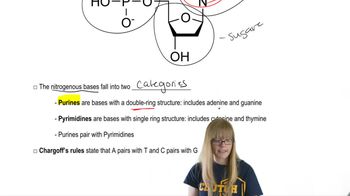
Chargoff's rules states that which nucleotide pairings occurred?
Table of contents
- 1. Introduction to Genetics51m
- 2. Mendel's Laws of Inheritance3h 37m
- 3. Extensions to Mendelian Inheritance2h 41m
- 4. Genetic Mapping and Linkage2h 28m
- 5. Genetics of Bacteria and Viruses1h 21m
- 6. Chromosomal Variation1h 48m
- 7. DNA and Chromosome Structure56m
- 8. DNA Replication1h 10m
- 9. Mitosis and Meiosis1h 34m
- 10. Transcription1h 0m
- 11. Translation58m
- 12. Gene Regulation in Prokaryotes1h 19m
- 13. Gene Regulation in Eukaryotes44m
- 14. Genetic Control of Development44m
- 15. Genomes and Genomics1h 50m
- 16. Transposable Elements47m
- 17. Mutation, Repair, and Recombination1h 6m
- 18. Molecular Genetic Tools19m
- 19. Cancer Genetics29m
- 20. Quantitative Genetics1h 26m
- 21. Population Genetics50m
- 22. Evolutionary Genetics29m
7. DNA and Chromosome Structure
DNA Structure
Problem 2
Textbook Question
Most center around DNA and RNA and their role of serving as the genetic material. Write a short essay that contrasts these molecules, including a comparison of advantages conferred by their structure that each of them has over the other in serving in this role.
Verified step by step guidance1
Begin by defining DNA and RNA, highlighting that both are nucleic acids composed of nucleotides, but differ in sugar components and nitrogenous bases. DNA contains deoxyribose sugar and uses thymine, while RNA contains ribose sugar and uses uracil instead of thymine.
Explain the structural differences: DNA is typically double-stranded forming a stable double helix, whereas RNA is usually single-stranded and can fold into various shapes. Discuss how the double-stranded nature of DNA provides stability and protection for genetic information.
Discuss the functional roles: DNA serves as the long-term storage of genetic information, while RNA plays multiple roles including messenger RNA (mRNA) for protein synthesis, transfer RNA (tRNA), and ribosomal RNA (rRNA).
Compare the advantages of DNA's structure, such as its chemical stability due to the lack of a hydroxyl group on the 2' carbon of deoxyribose, which makes it less prone to hydrolysis and mutation, making it ideal for long-term information storage.
Contrast this with RNA's advantages, such as its ability to fold into complex three-dimensional structures enabling catalytic activity (ribozymes) and its flexibility for diverse functions in gene expression and regulation.
Verified video answer for a similar problem:This video solution was recommended by our tutors as helpful for the problem above
Video duration:
1mPlay a video:
Was this helpful?
Key Concepts
Here are the essential concepts you must grasp in order to answer the question correctly.
Structural Differences Between DNA and RNA
DNA is a double-stranded molecule with a deoxyribose sugar and thymine bases, while RNA is typically single-stranded with a ribose sugar and uracil replacing thymine. These structural differences influence their stability and function in the cell.
Recommended video:
Guided course
DNA Structure
Stability and Function in Genetic Information Storage
DNA's double helix and deoxyribose sugar make it chemically more stable, ideal for long-term genetic information storage. RNA's single-stranded structure and ribose sugar make it more reactive and suitable for temporary roles like protein synthesis.
Recommended video:
Guided course
Functional Genomics
Functional Roles and Advantages in Genetic Processes
DNA serves as the permanent genetic blueprint, while RNA acts as a versatile intermediary in gene expression, including mRNA, tRNA, and rRNA. RNA's ability to fold into complex structures allows it to perform catalytic and regulatory functions that DNA cannot.
Recommended video:
Guided course
Functional Genomics
Related Videos
Related Practice
Multiple Choice
922
views
5
rank