Pearson+ LogoPearson+ Logo
Ch. 10 - DNA Structure and Analysis
Klug - Concepts of Genetics  12th Edition
Klug12th EditionConcepts of Genetics ISBN: 9780135564776Not the one you use?Change textbook
Chapter 10, Problem 4

Contrast the contributions made to an understanding of transformation by Griffith and by Avery and his colleagues.

Verified step by step guidance
1
Step 1: Understand the context of Griffith's experiment. Griffith worked with two strains of Streptococcus pneumoniae bacteria: a virulent smooth (S) strain with a polysaccharide capsule and a non-virulent rough (R) strain without the capsule. He observed that when he injected mice with heat-killed S strain and live R strain together, the mice died, and live S strain bacteria were recovered. This suggested that some 'transforming principle' from the dead S strain converted R strain into virulent S strain.
Step 2: Recognize the significance of Griffith's findings. His work demonstrated the phenomenon of transformation, where genetic material from one bacterial strain could be taken up by another, changing its phenotype. However, Griffith did not identify the chemical nature of the transforming substance.
Step 3: Examine Avery and his colleagues' contribution. Avery, MacLeod, and McCarty built on Griffith's work by isolating and purifying the transforming principle. They treated extracts from heat-killed S strain bacteria with enzymes that destroyed proteins, RNA, or DNA, and observed which treatment abolished transformation.
Step 4: Understand the key result from Avery's experiments. They found that only the destruction of DNA prevented transformation, indicating that DNA was the genetic material responsible for transformation, not proteins or RNA. This was a pivotal discovery in molecular genetics.
Step 5: Contrast the contributions. Griffith discovered the phenomenon of transformation but did not identify the transforming substance, while Avery and his colleagues provided strong experimental evidence that DNA is the molecule responsible for heredity and transformation.

Verified video answer for a similar problem:

This video solution was recommended by our tutors as helpful for the problem above.
Video duration:
2m
Was this helpful?

Key Concepts

Here are the essential concepts you must grasp in order to answer the question correctly.

Griffith's Experiment and Transformation

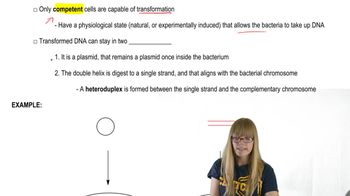
Frederick Griffith discovered the phenomenon of transformation in bacteria through his 1928 experiment with Streptococcus pneumoniae. He showed that non-virulent bacteria could become virulent when exposed to heat-killed virulent strains, suggesting that some 'transforming principle' transferred genetic information.
Recommended video:
Guided course
05:48
Transformation

Avery and Colleagues' Identification of DNA as the Transforming Principle

Oswald Avery and his team extended Griffith's work by demonstrating in 1944 that DNA, not protein or RNA, was the molecule responsible for transformation. They used enzymatic treatments to show that only DNA destruction prevented transformation, establishing DNA as the genetic material.
Recommended video:
Guided course
05:48
Transformation

Significance of Transformation in Molecular Genetics

Transformation revealed that genetic information could be transferred between cells, providing a foundation for molecular genetics. Griffith's discovery showed the phenomenon, while Avery's work identified DNA as the carrier, shifting the focus to DNA as the molecule of heredity.
Recommended video:
Guided course
05:48
Transformation