How would the results vary in cross (a) of Problem 32 if genes A and B were linked with no crossing over between them? How would the results of cross (a) vary if genes A and B were linked and 20 map units (mu) apart?
Verified step by step guidance
1
First, identify the original cross (a) from Problem 32 and determine the expected genotypic and phenotypic ratios assuming independent assortment (i.e., genes A and B are unlinked). This will serve as the baseline for comparison.
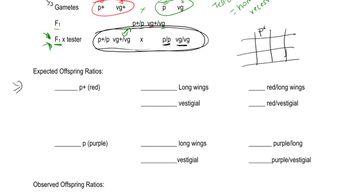
Next, consider the scenario where genes A and B are completely linked with no crossing over. In this case, the alleles on the same chromosome are inherited together as a single unit. Therefore, only parental gametes are produced, and recombinant gametes are absent. This will alter the expected offspring ratios compared to independent assortment.
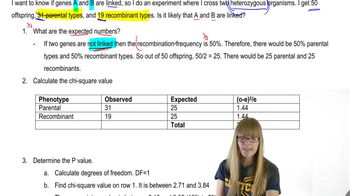
Then, analyze the case where genes A and B are linked but 20 map units apart. Since 1 map unit corresponds to a 1% recombination frequency, a distance of 20 map units means there is a 20% chance of crossing over between the genes. Calculate the expected frequencies of parental and recombinant gametes using the recombination frequency: parental gametes will be produced at 80% combined frequency, and recombinant gametes at 20% combined frequency.
Use these gamete frequencies to determine the expected genotypic and phenotypic ratios in the offspring for the 20 map unit scenario. This will show intermediate results between complete linkage (no recombination) and independent assortment (50% recombination).
Finally, compare all three scenarios—independent assortment, complete linkage, and linkage with 20 map units—to understand how linkage and recombination frequency affect the genetic outcomes of the cross.
Verified video answer for a similar problem:
This video solution was recommended by our tutors as helpful for the problem above
Video duration:
1m
Play a video:
Was this helpful?
Key Concepts
Here are the essential concepts you must grasp in order to answer the question correctly.
Genetic Linkage
Genetic linkage occurs when two genes are located close together on the same chromosome and tend to be inherited together. This reduces the likelihood of independent assortment, causing parental allele combinations to appear more frequently than recombinant types in offspring.
Crossing over is the exchange of genetic material between homologous chromosomes during meiosis, producing recombinant gametes. The recombination frequency, expressed in map units (mu), reflects the distance between genes; 1 mu corresponds to a 1% chance of crossover between two genes.
Effect of Linkage Distance on Genetic Cross Outcomes
When genes are completely linked with no crossing over, only parental gametes are produced, resulting in no recombinant offspring. If genes are linked but separated by 20 map units, crossing over occurs at a 20% frequency, producing both parental and recombinant offspring in predictable ratios.