Pearson+ LogoPearson+ Logo
Ch. 19 - Epigenetics
Klug - Concepts of Genetics  12th Edition
Klug12th EditionConcepts of Genetics ISBN: 9780135564776Not the one you use?Change textbook
Chapter 19, Problem 22b

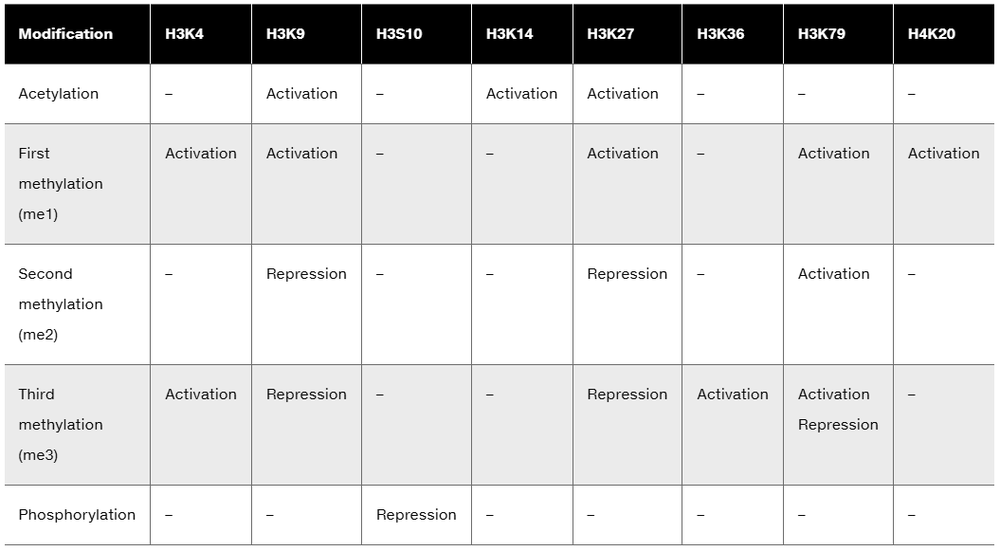
From the following table, draw up a list of histone H3 modifications associated with gene activation. Then draw up a list of H3 modifications associated with repression.
Are these overlaps explained by different modifications?

Verified step by step guidance
1
Step 1: Understand that histone H3 modifications are chemical changes to the histone protein that affect chromatin structure and gene expression. Common modifications include methylation, acetylation, phosphorylation, and ubiquitination, each occurring at specific amino acid residues on histone H3.
Step 2: Compile a list of histone H3 modifications associated with gene activation. These typically include acetylation at lysine residues such as H3K9ac (acetylation at lysine 9) and H3K27ac, as well as methylation marks like H3K4me3 (trimethylation at lysine 4), which are known to correlate with active transcription.
Step 3: Compile a list of histone H3 modifications associated with gene repression. These often include methylation marks such as H3K9me3 and H3K27me3, which are linked to heterochromatin formation and transcriptional silencing.
Step 4: Analyze whether there is overlap between activating and repressing modifications. Consider that some residues can be modified in different ways (e.g., methylation vs. acetylation) leading to different functional outcomes, and that the same residue can carry different modifications in different contexts.
Step 5: Conclude that the overlaps in histone H3 modifications are explained by the fact that different types of chemical modifications at the same or different residues can have distinct effects on gene expression, highlighting the complexity and combinatorial nature of the histone code.

Verified video answer for a similar problem:

This video solution was recommended by our tutors as helpful for the problem above.
Video duration:
1m
Was this helpful?

Key Concepts

Here are the essential concepts you must grasp in order to answer the question correctly.

Histone H3 Modifications and Their Role in Gene Regulation

Histone H3 undergoes various post-translational modifications, such as methylation and acetylation, which influence chromatin structure and gene expression. Specific modifications can either promote gene activation by loosening chromatin or cause repression by tightening it, thus controlling access to DNA.
Recommended video:
Guided course
07:55
Histone Protein Modifications

Histone Code Hypothesis and Modification Specificity

The histone code hypothesis suggests that distinct combinations of histone modifications create a regulatory language that determines gene activity. Different modifications on histone H3, like methylation at different lysine residues, can have opposing effects, explaining how overlapping modifications can lead to activation or repression.
Recommended video:
Guided course
07:55
Histone Protein Modifications

Functional Overlap and Context-Dependence of Histone Modifications

Some histone H3 modifications may appear in both active and repressed genes, but their effects depend on the specific residue modified, the type of modification, and the presence of other marks. This context-dependence allows for complex regulation and explains overlaps in modification patterns.
Recommended video:
Guided course
07:55
Histone Protein Modifications
Related Practice
Textbook Question

Prader–Willi syndrome (PWS) is a genetic disorder with a clinical profile of obesity, intellectual disability, and short stature. It can be caused in several ways. Most common is a deletion on the paternal copy of chromosome 15, but it can also be caused by an epigenetic imprinting disorder and uniparental disomy, an event in which the affected child receives two copies of the maternal chromosome 15. A child with PWS comes to your clinic for a diagnosis of the molecular basis for this condition. The gel below shows the results of testing with short tandem repeats (STRs) from the region of chromosome 15 associated with the disorder.

Is this case caused by a deletion in the paternal copy of chromosome 15? Explain.

1274
views
Textbook Question

Prader–Willi syndrome (PWS) is a genetic disorder with a clinical profile of obesity, intellectual disability, and short stature. It can be caused in several ways. Most common is a deletion on the paternal copy of chromosome 15, but it can also be caused by an epigenetic imprinting disorder and uniparental disomy, an event in which the affected child receives two copies of the maternal chromosome 15. A child with PWS comes to your clinic for a diagnosis of the molecular basis for this condition. The gel below shows the results of testing with short tandem repeats (STRs) from the region of chromosome 15 associated with the disorder.

Based on your interpretation of the data, what is the cause of PWS in this case? Explain your reasoning. 

1105
views
Textbook Question

From the following table, draw up a list of histone H3 modifications associated with gene activation. Then draw up a list of H3 modifications associated with repression.

Are there any overlaps on the lists?

482
views
Textbook Question

From the following table, draw up a list of histone H3 modifications associated with gene activation. Then draw up a list of H3 modifications associated with repression.

If not, how can you reconcile these differences?

427
views
Textbook Question

Amino acids are classified as positively charged, negatively charged, or electrically neutral.

Which category includes lysine?

574
views
Textbook Question

Amino acids are classified as positively charged, negatively charged, or electrically neutral.

How does this property of lysine allow it to interact with DNA?

627
views