Pearson+ LogoPearson+ Logo
Ch. 19 - Epigenetics
Klug - Concepts of Genetics  12th Edition
Klug12th EditionConcepts of Genetics ISBN: 9780135564776Not the one you use?Change textbook
Chapter 19, Problem 21a

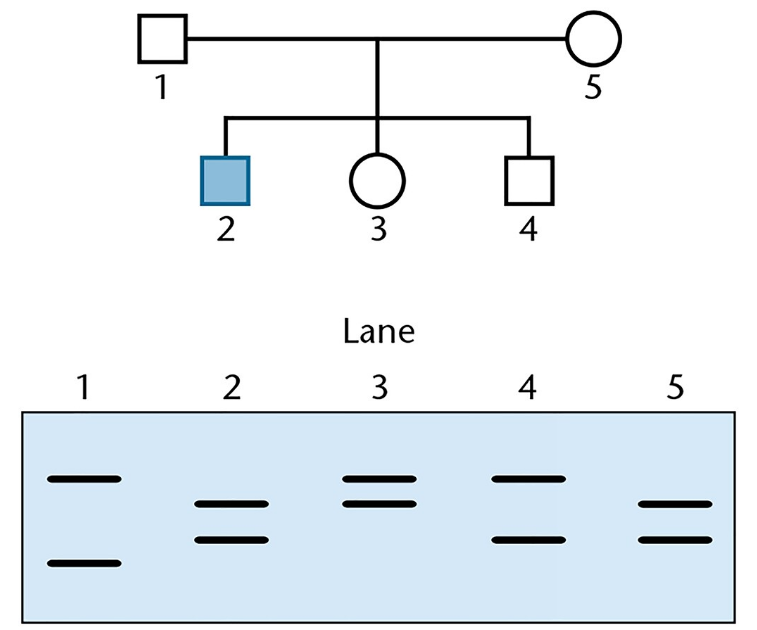
Prader–Willi syndrome (PWS) is a genetic disorder with a clinical profile of obesity, intellectual disability, and short stature. It can be caused in several ways. Most common is a deletion on the paternal copy of chromosome 15, but it can also be caused by an epigenetic imprinting disorder and uniparental disomy, an event in which the affected child receives two copies of the maternal chromosome 15. A child with PWS comes to your clinic for a diagnosis of the molecular basis for this condition. The gel below shows the results of testing with short tandem repeats (STRs) from the region of chromosome 15 associated with the disorder.
Is this case caused by a deletion in the paternal copy of chromosome 15? Explain.

Verified step by step guidance
1
Understand the genetic basis of Prader–Willi syndrome (PWS): it is caused by the loss of function of genes on the paternal chromosome 15, either due to a deletion, uniparental disomy (two maternal copies), or imprinting defects.
Examine the STR (short tandem repeat) gel results to determine the presence or absence of paternal alleles. STR markers are highly polymorphic and can distinguish between maternal and paternal chromosome contributions based on band patterns.
Look for the presence of paternal-specific STR bands. If the paternal allele is deleted, the gel will show only maternal bands (one band per marker) because the paternal bands are missing.
If two maternal bands appear (or a single band matching maternal alleles but no paternal bands), this suggests uniparental disomy rather than a deletion. Conversely, if one band is missing (paternal band absent) and only maternal bands are present, this supports a deletion on the paternal chromosome.
Summarize your interpretation by comparing the banding pattern to the expected normal pattern (both maternal and paternal bands present). Use this comparison to conclude whether the PWS case is caused by a paternal deletion or another mechanism.

Verified video answer for a similar problem:

This video solution was recommended by our tutors as helpful for the problem above.
Video duration:
1m
Was this helpful?

Key Concepts

Here are the essential concepts you must grasp in order to answer the question correctly.

Prader–Willi Syndrome and Genetic Causes

Prader–Willi syndrome (PWS) is a genetic disorder caused by loss of function of genes on the paternal chromosome 15q11-q13 region. It can result from a paternal deletion, maternal uniparental disomy (two maternal copies), or imprinting defects. Understanding these mechanisms is essential to interpret genetic test results and diagnose the molecular cause.
Recommended video:
Guided course
07:39
Genetic Cloning

Short Tandem Repeats (STRs) and Genetic Testing

STRs are repetitive DNA sequences used as markers in genetic testing to track inheritance patterns. By comparing STR alleles from parents and child, one can determine if a chromosome segment is missing (deletion) or if both copies come from one parent (uniparental disomy). STR analysis helps identify the molecular basis of disorders like PWS.
Recommended video:
Guided course
11:43
The Genetic Code

Genomic Imprinting and Parent-of-Origin Effects

Genomic imprinting is an epigenetic phenomenon where gene expression depends on the parent of origin. In PWS, only the paternal allele is active; loss of this allele’s function leads to disease. Recognizing imprinting effects is crucial to understanding why deletions or uniparental disomy cause PWS despite normal gene dosage.
Recommended video:
Guided course
03:38
Maternal Effect
Related Practice
Textbook Question

A developmental disorder in humans called spina bifida is a neural tube defect linked to a maternal diet low in folate during pregnancy.

Does this exclude genetic mutations as a cause of this condition?

367
views
Textbook Question

A developmental disorder in humans called spina bifida is a neural tube defect linked to a maternal diet low in folate during pregnancy.

Should researchers be looking for mutant alleles of genes that control formation and differentiation of the neural tube?

453
views
Textbook Question

Trace the relationship between the methylation status of the glucocorticoid receptor gene and the behavioral response to stress.

674
views
Textbook Question

Prader–Willi syndrome (PWS) is a genetic disorder with a clinical profile of obesity, intellectual disability, and short stature. It can be caused in several ways. Most common is a deletion on the paternal copy of chromosome 15, but it can also be caused by an epigenetic imprinting disorder and uniparental disomy, an event in which the affected child receives two copies of the maternal chromosome 15. A child with PWS comes to your clinic for a diagnosis of the molecular basis for this condition. The gel below shows the results of testing with short tandem repeats (STRs) from the region of chromosome 15 associated with the disorder.

Based on your interpretation of the data, what is the cause of PWS in this case? Explain your reasoning. 

1105
views
Textbook Question

From the following table, draw up a list of histone H3 modifications associated with gene activation. Then draw up a list of H3 modifications associated with repression.

Are there any overlaps on the lists?

482
views
Textbook Question

From the following table, draw up a list of histone H3 modifications associated with gene activation. Then draw up a list of H3 modifications associated with repression.

Are these overlaps explained by different modifications?

485
views