A species has 2n = 20. How many chromosomes will be found per mutant cell in an monosomic organism.
Table of contents
- 1. Introduction to Genetics51m
- 2. Mendel's Laws of Inheritance3h 37m
- 3. Extensions to Mendelian Inheritance2h 41m
- 4. Genetic Mapping and Linkage2h 28m
- 5. Genetics of Bacteria and Viruses1h 21m
- 6. Chromosomal Variation1h 48m
- 7. DNA and Chromosome Structure56m
- 8. DNA Replication1h 10m
- 9. Mitosis and Meiosis1h 34m
- 10. Transcription1h 0m
- 11. Translation58m
- 12. Gene Regulation in Prokaryotes1h 19m
- 13. Gene Regulation in Eukaryotes44m
- 14. Genetic Control of Development44m
- 15. Genomes and Genomics1h 50m
- 16. Transposable Elements47m
- 17. Mutation, Repair, and Recombination1h 6m
- 18. Molecular Genetic Tools19m
- 19. Cancer Genetics29m
- 20. Quantitative Genetics1h 26m
- 21. Population Genetics50m
- 22. Evolutionary Genetics29m
6. Chromosomal Variation
Chromosomal Mutations: Aneuploidy
Problem 4
Textbook Question
For a species with a diploid number of 18, indicate how many chromosomes will be present in the somatic nuclei of individuals that are haploid, tetraploid, trisomic, and monosomic.
Verified step by step guidance1
Identify the diploid number (2n) of the species, which is given as 18. This means the normal somatic cells have 18 chromosomes arranged in pairs.
Calculate the haploid number (n), which is half of the diploid number. Use the formula: \(n = \frac{2n}{2}\).
Determine the chromosome number in haploid individuals, which is simply the haploid number \(n\).
Calculate the chromosome number in tetraploid individuals, which have four sets of chromosomes. Use the formula: \$4n$.
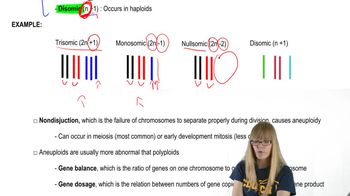
For trisomic and monosomic individuals, start with the diploid number and then add or subtract one chromosome respectively. Use the formulas: trisomic = \$2n + 1\( and monosomic = \)2n - 1$.
Verified video answer for a similar problem:This video solution was recommended by our tutors as helpful for the problem above
Video duration:
2mPlay a video:
Was this helpful?
Key Concepts
Here are the essential concepts you must grasp in order to answer the question correctly.
Diploid Number and Ploidy Levels
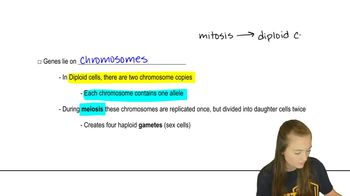
The diploid number (2n) represents the total chromosomes in somatic cells, with two sets from each parent. Haploid cells (n) have half this number, while polyploid cells like tetraploids have multiple sets (e.g., 4n). Understanding ploidy helps determine chromosome counts in different cell types.
Recommended video:
Guided course
Diploid Genetics
Aneuploidy: Trisomy and Monosomy
Aneuploidy refers to the presence of an abnormal number of chromosomes. Trisomy means having one extra chromosome (2n + 1), while monosomy means missing one chromosome (2n - 1). These conditions alter chromosome counts from the normal diploid number.
Recommended video:
Guided course
Aneuploidy
Chromosome Counting in Somatic Cells
Somatic cells contain the full chromosome complement based on ploidy and aneuploidy status. Calculating chromosome numbers involves applying the ploidy level or aneuploid condition to the diploid number, enabling determination of chromosome counts in various genetic scenarios.
Recommended video:
Guided course
Cell-cell interactions
Related Videos
Related Practice
Multiple Choice
740
views
5
rank
