Describe a tautomeric shift and how it may lead to a mutation.
Table of contents
- 1. Introduction to Genetics51m
- 2. Mendel's Laws of Inheritance3h 37m
- 3. Extensions to Mendelian Inheritance2h 41m
- 4. Genetic Mapping and Linkage2h 28m
- 5. Genetics of Bacteria and Viruses1h 21m
- 6. Chromosomal Variation1h 48m
- 7. DNA and Chromosome Structure56m
- 8. DNA Replication1h 10m
- 9. Mitosis and Meiosis1h 34m
- 10. Transcription1h 0m
- 11. Translation58m
- 12. Gene Regulation in Prokaryotes1h 19m
- 13. Gene Regulation in Eukaryotes44m
- 14. Genetic Control of Development44m
- 15. Genomes and Genomics1h 50m
- 16. Transposable Elements47m
- 17. Mutation, Repair, and Recombination1h 6m
- 18. Molecular Genetic Tools19m
- 19. Cancer Genetics29m
- 20. Quantitative Genetics1h 26m
- 21. Population Genetics50m
- 22. Evolutionary Genetics29m
17. Mutation, Repair, and Recombination
Spontaneous Mutations
Problem 1c
Textbook Question
How do we know that DNA repair mechanisms detect and correct the majority of spontaneous and induced mutations?
Verified step by step guidance1
Understand that DNA repair mechanisms are cellular processes that identify and fix damage or errors in the DNA sequence to maintain genetic integrity.
Recognize that spontaneous mutations arise naturally due to errors in DNA replication or chemical changes, while induced mutations result from external factors like UV light or chemicals.
Examine experimental evidence where cells with defective DNA repair genes show higher mutation rates compared to normal cells, indicating that repair systems normally correct many mutations.
Consider mutation frequency assays that compare mutation rates before and after exposure to mutagens, showing that repair mechanisms reduce the number of mutations that persist.
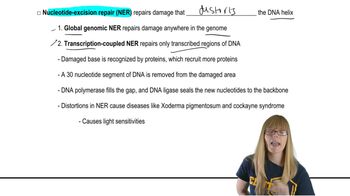
Review molecular studies that identify specific repair pathways (e.g., nucleotide excision repair, base excision repair) and their role in detecting and correcting different types of DNA damage.
Verified video answer for a similar problem:This video solution was recommended by our tutors as helpful for the problem above
Video duration:
1mPlay a video:
Was this helpful?
Key Concepts
Here are the essential concepts you must grasp in order to answer the question correctly.
DNA Repair Mechanisms
DNA repair mechanisms are cellular processes that identify and correct damage or errors in the DNA sequence. These include pathways like base excision repair, nucleotide excision repair, and mismatch repair, which maintain genetic stability by fixing spontaneous or induced mutations before they become permanent.
Recommended video:
Guided course
Repair Pathways
Mutation Detection and Correction Evidence
Experimental evidence for DNA repair includes increased mutation rates in repair-deficient mutants, observation of repair enzyme activity, and molecular assays showing removal of damaged bases. These findings demonstrate that cells actively detect and correct most mutations, preventing their accumulation.
Recommended video:
Guided course
Mutations and Phenotypes
Spontaneous vs. Induced Mutations
Spontaneous mutations arise naturally from DNA replication errors or chemical changes, while induced mutations result from external agents like UV light or chemicals. DNA repair systems are adapted to recognize and fix both types, highlighting their role in protecting genome integrity under various conditions.
Recommended video:
Guided course
Spontaneous Mutations
Related Videos
Related Practice
Textbook Question
1286
views