Pearson+ LogoPearson+ Logo
Ch. 10 - DNA Structure and Analysis
Klug - Concepts of Genetics  12th Edition
Klug12th EditionConcepts of Genetics ISBN: 9780135564776Not the one you use?Change textbook
Chapter 10, Problem 1d

How do we know that G pairs with C and that A pairs with T as complementary base pairs are formed?

Verified step by step guidance
1
Understand the chemical structure of the four DNA bases: adenine (A), thymine (T), guanine (G), and cytosine (C). Each base has specific sites capable of forming hydrogen bonds.
Examine the hydrogen bonding patterns: A and T form two hydrogen bonds, while G and C form three hydrogen bonds. This difference in bonding strength contributes to the specificity of base pairing.
Consider the molecular shapes and sizes: purines (A and G) are larger, double-ring structures, and pyrimidines (T and C) are smaller, single-ring structures. Complementary base pairs consist of one purine and one pyrimidine, maintaining a uniform width of the DNA double helix.
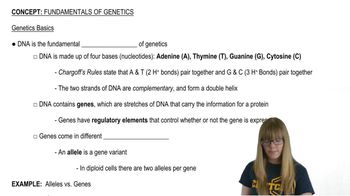
Review experimental evidence such as Chargaff's rules, which show that the amount of adenine equals thymine and the amount of guanine equals cytosine in DNA, supporting the complementary pairing concept.
Look at X-ray crystallography data of DNA, which reveals the spatial arrangement of bases and confirms that A pairs with T and G pairs with C through specific hydrogen bonding, stabilizing the double helix structure.

Verified video answer for a similar problem:

This video solution was recommended by our tutors as helpful for the problem above.
Video duration:
2m
Was this helpful?

Key Concepts

Here are the essential concepts you must grasp in order to answer the question correctly.

Base Pairing Rules

Base pairing rules describe how nucleotides pair specifically in DNA: adenine (A) pairs with thymine (T), and guanine (G) pairs with cytosine (C). This specificity is due to the hydrogen bonding patterns and molecular structures, ensuring accurate DNA replication and stable double helix formation.
Recommended video:
Guided course
03:49
Base Distortions

Chargaff's Rules

Chargaff's rules state that in DNA, the amount of adenine equals thymine, and the amount of guanine equals cytosine. This empirical observation provided key evidence for complementary base pairing, showing a consistent 1:1 ratio between these bases across different species.
Recommended video:
Guided course
08:44
Genetics Basics

X-ray Crystallography of DNA

X-ray crystallography provided detailed images of DNA's structure, revealing the double helix and the specific pairing of bases. Rosalind Franklin's X-ray diffraction patterns helped Watson and Crick deduce that A pairs with T and G pairs with C, based on the molecular dimensions and hydrogen bonding.
Recommended video:
Guided course
09:30
X-Inactivation