Write a short essay that distinguishes between the terms replication and synthesis, as applied to DNA. Which of the two is most closely allied with the field of biochemistry?
Table of contents
- 1. Introduction to Genetics51m
- 2. Mendel's Laws of Inheritance3h 37m
- 3. Extensions to Mendelian Inheritance2h 41m
- 4. Genetic Mapping and Linkage2h 28m
- 5. Genetics of Bacteria and Viruses1h 21m
- 6. Chromosomal Variation1h 48m
- 7. DNA and Chromosome Structure56m
- 8. DNA Replication1h 10m
- 9. Mitosis and Meiosis1h 34m
- 10. Transcription1h 0m
- 11. Translation58m
- 12. Gene Regulation in Prokaryotes1h 19m
- 13. Gene Regulation in Eukaryotes44m
- 14. Genetic Control of Development44m
- 15. Genomes and Genomics1h 50m
- 16. Transposable Elements47m
- 17. Mutation, Repair, and Recombination1h 6m
- 18. Molecular Genetic Tools19m
- 19. Cancer Genetics29m
- 20. Quantitative Genetics1h 26m
- 21. Population Genetics50m
- 22. Evolutionary Genetics29m
8. DNA Replication
Overview of DNA Replication
Problem 6
Textbook Question
What are the requirements for in vitro synthesis of DNA under the direction of DNA polymerase I?
Verified step by step guidance1
Understand that DNA polymerase I requires a template strand of DNA to guide the synthesis of the new DNA strand, so the first requirement is a single-stranded DNA template.
Recognize that DNA polymerase I cannot initiate DNA synthesis de novo; it needs a primer with a free 3'-OH group to add nucleotides, so a primer annealed to the template is necessary.
Provide the four deoxyribonucleotide triphosphates (dNTPs): dATP, dTTP, dGTP, and dCTP, which serve as the building blocks for the new DNA strand.
Include the DNA polymerase I enzyme itself, which catalyzes the polymerization reaction by adding nucleotides to the primer in the 5' to 3' direction.
Ensure the reaction mixture contains an appropriate buffer with Mg^{2+} ions, as these are essential cofactors for the enzymatic activity of DNA polymerase I.
Verified video answer for a similar problem:This video solution was recommended by our tutors as helpful for the problem above
Video duration:
1mPlay a video:
Was this helpful?
Key Concepts
Here are the essential concepts you must grasp in order to answer the question correctly.
Role of DNA Polymerase I
DNA Polymerase I is an enzyme that synthesizes DNA by adding nucleotides to a pre-existing strand. It requires a template strand to guide the sequence and can also remove RNA primers through its exonuclease activity, making it essential for DNA replication and repair.
Recommended video:
Guided course
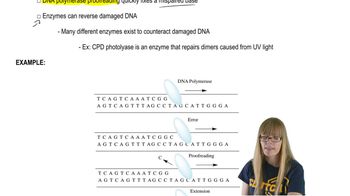
DNA Proofreading
Requirements for DNA Synthesis
In vitro DNA synthesis by DNA Polymerase I requires a single-stranded DNA template, a primer with a free 3'-OH group to initiate synthesis, all four deoxynucleotide triphosphates (dNTPs) as substrates, and appropriate buffer conditions including Mg2+ ions for enzyme activity.
Recommended video:
Guided course
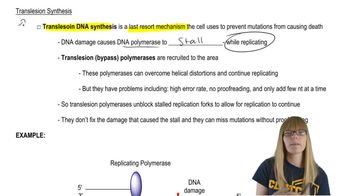
Translesion Synthesis
Primer-Template Structure
DNA Polymerase I cannot start DNA synthesis de novo; it needs a primer annealed to the template strand. The primer provides the free 3'-OH end necessary for the enzyme to add nucleotides, ensuring accurate and efficient DNA elongation.
Recommended video:
Guided course
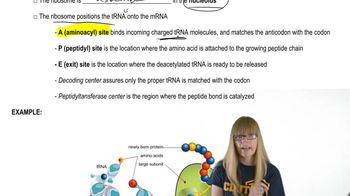
Ribosome Structure
Related Videos
Related Practice
Textbook Question
574
views