Pearson+ LogoPearson+ Logo
Ch. 11 - DNA Replication and Recombination
Klug - Concepts of Genetics  12th Edition
Klug12th EditionConcepts of Genetics ISBN: 9780135564776Not the one you use?Change textbook
Chapter 11, Problem 5

Predict the results of the experiment by Taylor, Woods, and Hughes if replication were
(a) conservative and
(b) dispersive.

Verified step by step guidance
1
Step 1: Understand the original experiment by Taylor, Woods, and Hughes, which used radioactive thymidine to label DNA and track replication patterns in chromosomes. The key observation was the distribution of labeled and unlabeled DNA after one and two rounds of replication.
Step 2: For the conservative replication model, predict that after one round of replication, one daughter DNA molecule would be fully labeled (containing the original labeled strand) and the other would be completely unlabeled (newly synthesized strands). After the second round, you would expect a similar pattern with a mix of fully labeled and fully unlabeled DNA molecules.
Step 3: For the dispersive replication model, predict that after one round of replication, all DNA molecules would contain a mixture of labeled and unlabeled segments within each strand, resulting in intermediate labeling throughout. After the second round, the label would be further diluted but still present in all DNA molecules, with no fully labeled or fully unlabeled strands.
Step 4: Compare these predictions to the actual experimental results, which showed semi-conservative replication, where each daughter molecule contains one labeled (old) strand and one unlabeled (new) strand after the first replication.
Step 5: Summarize that the conservative model predicts distinct fully labeled and unlabeled DNA molecules, while the dispersive model predicts uniformly mixed labeling in all DNA molecules, which contrasts with the semi-conservative pattern observed by Taylor, Woods, and Hughes.

Verified video answer for a similar problem:

This video solution was recommended by our tutors as helpful for the problem above.
Video duration:
41s
Was this helpful?

Key Concepts

Here are the essential concepts you must grasp in order to answer the question correctly.

DNA Replication Models

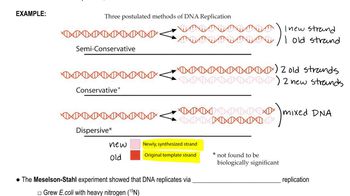
DNA replication can occur via three models: conservative, semiconservative, and dispersive. The conservative model suggests the original DNA molecule remains intact while a completely new copy is made. Understanding these models is essential to predict experimental outcomes related to DNA synthesis.
Recommended video:
Guided course
11:59
Steps to DNA Replication

Taylor, Woods, and Hughes Experiment

This experiment used radioactive thymidine to track DNA replication in root tip cells of Vicia faba. By analyzing chromosome labeling patterns after replication, they provided evidence supporting the semiconservative model. Knowing the experiment's design helps predict results under alternative replication models.
Recommended video:
Guided course
08:06
Mendel's Experiments

Predicted Outcomes of Conservative and Dispersive Replication

In conservative replication, one daughter molecule is fully labeled and the other unlabeled after one replication round. In dispersive replication, DNA strands are hybrids of old and new segments, resulting in uniformly mixed labeling. These patterns differ from semiconservative replication and are key to interpreting experimental data.
Recommended video:
Guided course
14:31
Semiconservative Replication