Why is a random mutation more likely to be deleterious than beneficial?
Table of contents
- 1. Introduction to Genetics51m
- 2. Mendel's Laws of Inheritance3h 37m
- 3. Extensions to Mendelian Inheritance2h 41m
- 4. Genetic Mapping and Linkage2h 28m
- 5. Genetics of Bacteria and Viruses1h 21m
- 6. Chromosomal Variation1h 48m
- 7. DNA and Chromosome Structure56m
- 8. DNA Replication1h 10m
- 9. Mitosis and Meiosis1h 34m
- 10. Transcription1h 0m
- 11. Translation58m
- 12. Gene Regulation in Prokaryotes1h 19m
- 13. Gene Regulation in Eukaryotes44m
- 14. Genetic Control of Development44m
- 15. Genomes and Genomics1h 50m
- 16. Transposable Elements47m
- 17. Mutation, Repair, and Recombination1h 6m
- 18. Molecular Genetic Tools19m
- 19. Cancer Genetics29m
- 20. Quantitative Genetics1h 26m
- 21. Population Genetics50m
- 22. Evolutionary Genetics29m
17. Mutation, Repair, and Recombination
Types of Mutations
Problem 8
Textbook Question
What is the difference between a silent mutation and a neutral mutation?
Verified step by step guidance1
Step 1: Understand that both silent mutations and neutral mutations are types of genetic mutations that do not have an obvious harmful effect on the organism, but they differ in their specific definitions and contexts.
Step 2: Define a silent mutation as a change in the DNA sequence that does not alter the amino acid sequence of the protein due to the redundancy of the genetic code. This means the codon changes but still codes for the same amino acid.
Step 3: Define a neutral mutation as a mutation that changes the amino acid sequence of a protein but does not affect the protein's function or the organism's fitness. This can include changes that are biochemically similar or occur in non-critical regions of the protein.
Step 4: Highlight that the key difference is that silent mutations do not change the protein sequence at all, while neutral mutations do change the protein sequence but without functional consequences.
Step 5: Summarize by noting that silent mutations are a subset of neutral mutations, but not all neutral mutations are silent; some neutral mutations are missense mutations that do not affect protein function.
Verified video answer for a similar problem:This video solution was recommended by our tutors as helpful for the problem above
Video duration:
47sPlay a video:
Was this helpful?
Key Concepts
Here are the essential concepts you must grasp in order to answer the question correctly.
Silent Mutation
A silent mutation is a change in the DNA sequence that does not alter the amino acid sequence of the resulting protein. This occurs because of the redundancy in the genetic code, where multiple codons can code for the same amino acid. Silent mutations typically have no effect on protein function.
Recommended video:
Guided course
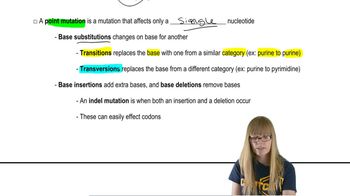
Point Mutations
Neutral Mutation
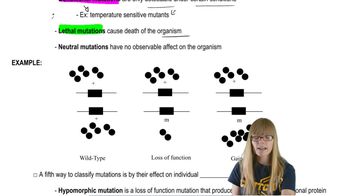
A neutral mutation is a genetic change that does not affect the organism's fitness or phenotype. Unlike silent mutations, neutral mutations may alter the amino acid sequence but do not impact the protein's function or the organism's survival and reproduction.
Recommended video:
Guided course
Mutations and Phenotypes
Genetic Code Redundancy and Mutation Effects
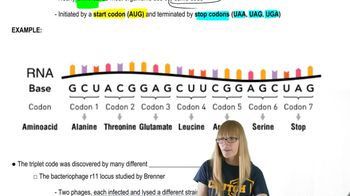
The genetic code is redundant, meaning multiple codons can specify the same amino acid, which allows some mutations to be silent. Understanding how mutations affect protein structure and function helps distinguish between silent mutations (no amino acid change) and neutral mutations (amino acid change without functional impact).
Recommended video:
Guided course
The Genetic Code
Related Videos
Related Practice
Textbook Question
719
views