What is a spontaneous mutation, and why are spontaneous mutations rare?
Table of contents
- 1. Introduction to Genetics51m
- 2. Mendel's Laws of Inheritance3h 37m
- 3. Extensions to Mendelian Inheritance2h 41m
- 4. Genetic Mapping and Linkage2h 28m
- 5. Genetics of Bacteria and Viruses1h 21m
- 6. Chromosomal Variation1h 48m
- 7. DNA and Chromosome Structure56m
- 8. DNA Replication1h 10m
- 9. Mitosis and Meiosis1h 34m
- 10. Transcription1h 0m
- 11. Translation58m
- 12. Gene Regulation in Prokaryotes1h 19m
- 13. Gene Regulation in Eukaryotes44m
- 14. Genetic Control of Development44m
- 15. Genomes and Genomics1h 50m
- 16. Transposable Elements47m
- 17. Mutation, Repair, and Recombination1h 6m
- 18. Molecular Genetic Tools19m
- 19. Cancer Genetics29m
- 20. Quantitative Genetics1h 26m
- 21. Population Genetics50m
- 22. Evolutionary Genetics29m
17. Mutation, Repair, and Recombination
Spontaneous Mutations
Problem 24
Textbook Question
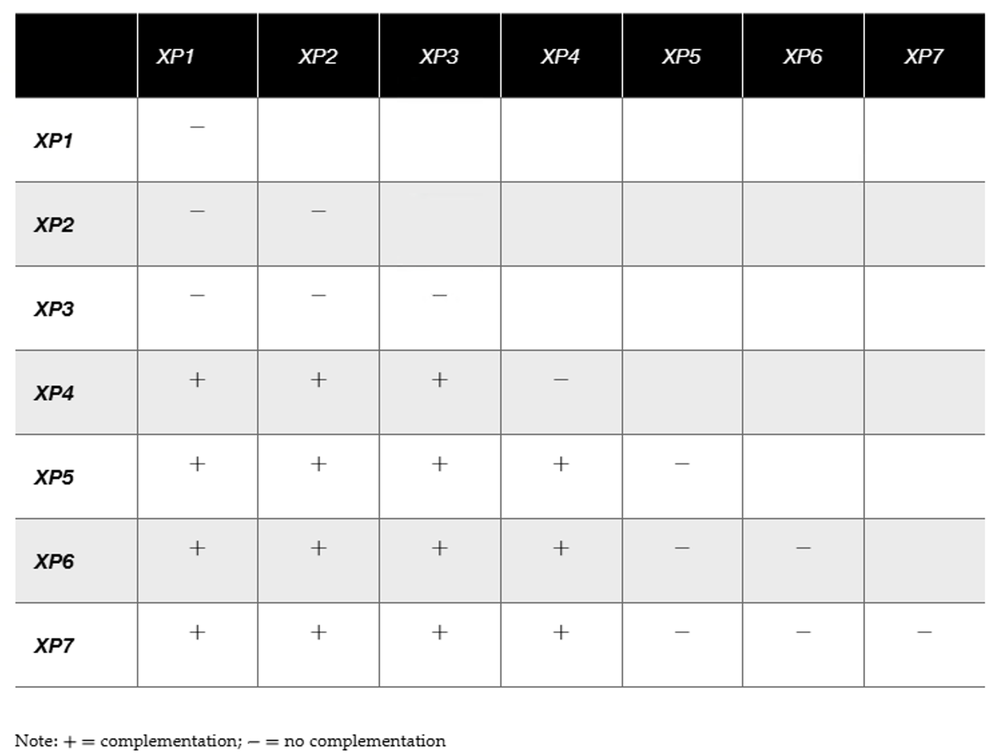
Presented here are hypothetical findings from studies of heterokaryons formed from seven human xeroderma pigmentosum cell strains:

These data are measurements of the occurrence or nonoccurrence of unscheduled DNA synthesis in the fused heterokaryon. None of the strains alone shows any unscheduled DNA synthesis. Which strains fall into the same complementation groups? How many different groups are revealed based on these data? What can we conclude about the genetic basis of XP from these data?
Verified step by step guidance1
Step 1: Understand the meaning of complementation in this context. Complementation (+) indicates that when two different XP strains are fused, the heterokaryon shows unscheduled DNA synthesis, meaning the mutations are in different genes. No complementation (-) means the mutations are in the same gene, so the defect is not rescued by fusion.
Step 2: Identify groups of strains that do not complement each other (marked with '-') to determine which strains belong to the same complementation group. For example, XP1, XP2, and XP3 show no complementation among themselves, so they likely belong to the same group.
Step 3: Look for strains that complement all others except themselves and their group members. For instance, XP4 complements XP1, XP2, and XP3 but not itself, indicating it forms a separate complementation group.
Step 4: Repeat this analysis for XP5, XP6, and XP7. Notice that XP5 complements XP1, XP2, XP3, and XP4 but not XP6 or XP7, suggesting XP5 is in a different group from XP6 and XP7. XP6 and XP7 do not complement each other, so they form another group.
Step 5: Summarize the findings: group the strains into distinct complementation groups based on the pattern of complementation (+) and non-complementation (-). Count the number of groups and conclude that xeroderma pigmentosum is genetically heterogeneous, caused by mutations in multiple different genes.
Verified video answer for a similar problem:This video solution was recommended by our tutors as helpful for the problem above
Video duration:
1mPlay a video:
Was this helpful?
Key Concepts
Here are the essential concepts you must grasp in order to answer the question correctly.
Complementation Testing
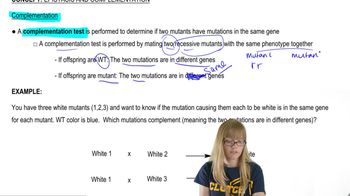
Complementation testing is a genetic technique used to determine whether two mutations causing a similar phenotype are in the same gene or in different genes. If two mutant strains complement each other (show a wild-type phenotype when combined), their mutations are in different genes. Lack of complementation indicates mutations in the same gene.
Recommended video:
Guided course
Complementation
Unscheduled DNA Synthesis (UDS)
Unscheduled DNA synthesis is a measure of DNA repair activity, specifically nucleotide excision repair, occurring outside of normal DNA replication. In xeroderma pigmentosum (XP) cells, UDS is absent due to defective repair. Restoration of UDS in heterokaryons indicates complementation and functional repair.
Recommended video:
Guided course
Translesion Synthesis
Genetic Heterogeneity in Xeroderma Pigmentosum
Xeroderma pigmentosum is genetically heterogeneous, meaning mutations in different genes can cause the disease. Complementation groups represent distinct genes involved in DNA repair. Identifying multiple complementation groups reveals the complexity and multiple genetic causes underlying XP.
Recommended video:
Guided course
Descriptive Genetics
Related Videos
Related Practice
Textbook Question
1187
views
