Table of contents
- 1. Introduction to Genetics51m
- 2. Mendel's Laws of Inheritance3h 37m
- 3. Extensions to Mendelian Inheritance2h 41m
- 4. Genetic Mapping and Linkage2h 28m
- 5. Genetics of Bacteria and Viruses1h 21m
- 6. Chromosomal Variation1h 48m
- 7. DNA and Chromosome Structure56m
- 8. DNA Replication1h 10m
- 9. Mitosis and Meiosis1h 34m
- 10. Transcription1h 0m
- 11. Translation58m
- 12. Gene Regulation in Prokaryotes1h 19m
- 13. Gene Regulation in Eukaryotes44m
- 14. Genetic Control of Development44m
- 15. Genomes and Genomics1h 50m
- 16. Transposable Elements47m
- 17. Mutation, Repair, and Recombination1h 6m
- 18. Molecular Genetic Tools19m
- 19. Cancer Genetics29m
- 20. Quantitative Genetics1h 26m
- 21. Population Genetics50m
- 22. Evolutionary Genetics29m
4. Genetic Mapping and Linkage
Mapping Overview
Problem 1d
Textbook Question
How do we know that sister chromatids undergo recombination during mitosis?
Verified step by step guidance1
Understand the biological context: Sister chromatids are identical copies of a chromosome formed during DNA replication in the S phase of the cell cycle, and mitosis is the process of cell division that ensures each daughter cell receives an identical set of chromosomes.
Recall that recombination typically occurs during meiosis to increase genetic diversity, but evidence shows that sister chromatids can also undergo recombination during mitosis, primarily for DNA repair purposes.
Examine experimental evidence such as the use of molecular markers or DNA sequencing techniques that detect exchange of genetic material between sister chromatids, indicating recombination events.
Consider cytological methods like fluorescence microscopy with labeled chromatids, which can visualize physical exchanges or crossover points between sister chromatids during mitosis.
Review genetic studies where mutations or DNA damage induce recombination between sister chromatids, demonstrating that mitotic recombination is a mechanism for maintaining genome stability rather than generating diversity.
Verified video answer for a similar problem:This video solution was recommended by our tutors as helpful for the problem above
Video duration:
2mPlay a video:
Was this helpful?
Key Concepts
Here are the essential concepts you must grasp in order to answer the question correctly.
Sister Chromatids and Their Structure
Sister chromatids are identical copies of a single chromosome connected by a centromere, formed during DNA replication in the S phase. Understanding their structure is essential because recombination involves the exchange of genetic material between these chromatids, which impacts genetic stability during cell division.
Recommended video:
Guided course
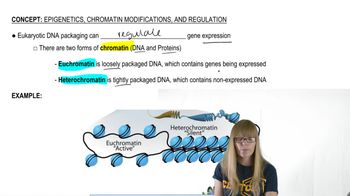
Chromatin
Mitotic Recombination Mechanism
Mitotic recombination refers to the exchange of genetic information between sister chromatids during mitosis, often as a repair mechanism for DNA damage. Unlike meiotic recombination, it is less frequent but crucial for maintaining genome integrity by correcting replication errors or breaks.
Recommended video:
Guided course
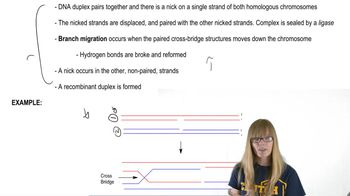
Recombination after Single Strand Breaks
Experimental Evidence for Sister Chromatid Recombination
Evidence for recombination during mitosis comes from genetic and molecular studies, such as marker segregation analysis and DNA repair assays, showing crossover events between sister chromatids. Techniques like fluorescence microscopy and molecular tagging help visualize and confirm these recombination events.
Recommended video:
Guided course
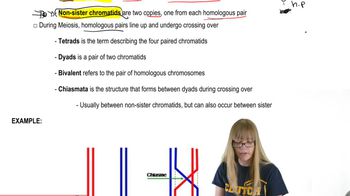
Crossing Over Terminology
Related Videos
Related Practice
Multiple Choice
A map distance of 23.6 between two genes indicates which of the following?
38
views