Textbook Question
The partial amino acid sequence of a wild-type protein is
… Arg-Met-Tyr-Thr-Leu-Cys-Ser …
The same portion of the protein from a mutant has the sequence
… Arg-Met-Leu-Tyr-Ala-Leu-Phe …
Identify the type of mutation.
715
views

 Sanders 3rd EditionCh. 11 - Gene Mutation, DNA Repair, and Homologous RecombinationProblem 19b
 Verified step by step guidance
 09:49
09:49
 06:25
06:25 05:05
05:05The partial amino acid sequence of a wild-type protein is
… Arg-Met-Tyr-Thr-Leu-Cys-Ser …
The same portion of the protein from a mutant has the sequence
… Arg-Met-Leu-Tyr-Ala-Leu-Phe …
Identify the type of mutation.
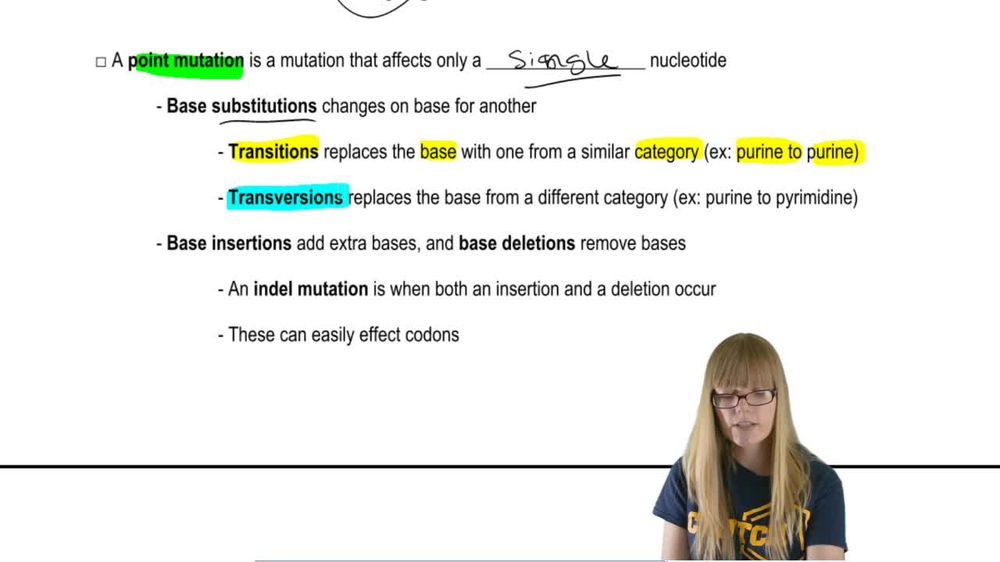
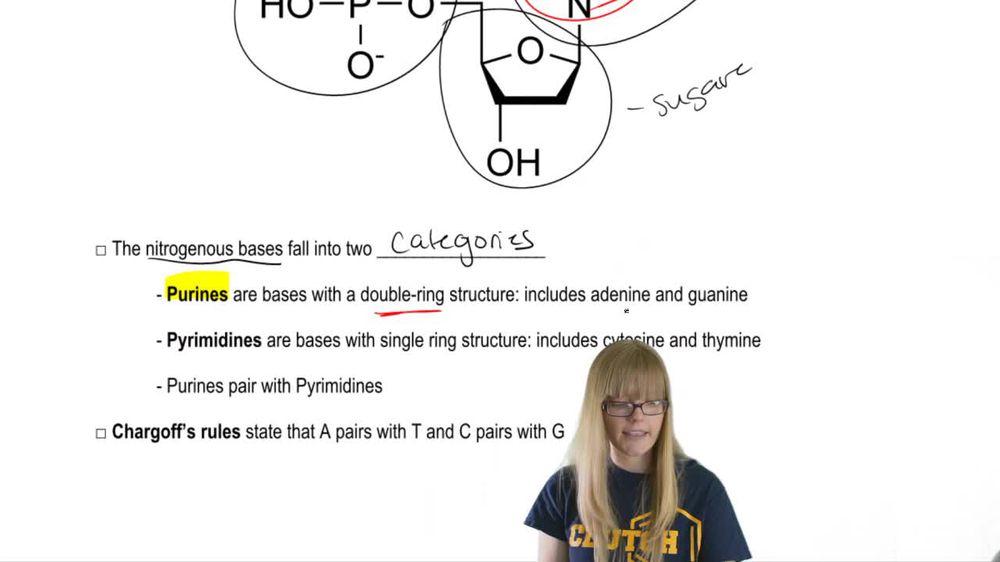
Using the adenine–thymine base pair in this DNA sequence
...GCTC...
...CGAG...
Give the sequence after a transition mutation.
The partial amino acid sequence of a wild-type protein is
… Arg-Met-Tyr-Thr-Leu-Cys-Ser …
The same portion of the protein from a mutant has the sequence
… Arg-Met-Leu-Tyr-Ala-Leu-Phe …
Give the sequence of the wild-type DNA template strand. Use A/G if the nucleotide could be either purine, T/C if it could be either pyrimidine, N if any nucleotide could occur at a site, or the alternative nucleotides if a purine and a pyrimidine are possible.
The two DNA and polypeptide sequences shown are for alleles at a hypothetical locus that produce different polypeptides, both five amino acids long. In each case, the lower DNA strand is the template strand:
Based on DNA and polypeptide sequences alone, is there any way to determine which allele is dominant and which is recessive? Why or why not?
Describe the difference between DNA transposons and retrotransposons.
How are flanking direct repeat sequences created by transposition?