How do we know that threshold traits are actually polygenic even though they may have as few as two discrete phenotypic classes?
Verified step by step guidance
1
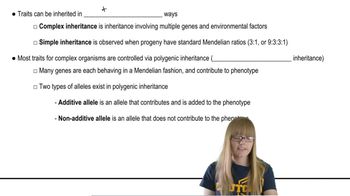
Understand the concept of threshold traits: Threshold traits are traits that exhibit discrete phenotypic classes (e.g., affected vs. unaffected) but are influenced by multiple genes and environmental factors. These traits are polygenic, meaning they are controlled by many genes, even though their phenotypic expression appears binary.
Recognize the role of liability: Liability is an underlying continuous variable that represents the combined genetic and environmental factors contributing to the trait. Individuals with liability above a certain threshold express one phenotype (e.g., affected), while those below the threshold express the other phenotype (e.g., unaffected).
Examine family studies and heritability: Threshold traits often show familial aggregation, meaning they are more common in families with affected individuals. This pattern suggests a genetic basis, as relatives share genetic factors that contribute to liability. Heritability studies further support the polygenic nature of these traits by quantifying the genetic contribution to liability.
Analyze population data: In populations, the distribution of liability typically follows a normal curve, consistent with the influence of multiple genes. The threshold for phenotypic expression divides this continuous distribution into discrete classes, reinforcing the idea that the trait is polygenic.
Consider genetic and environmental interactions: Threshold traits are influenced by both genetic and environmental factors. The interaction between these factors can shift an individual's liability, pushing them above or below the threshold. This complexity aligns with the polygenic model, where multiple genes and environmental inputs collectively determine the trait.
Verified video answer for a similar problem:
This video solution was recommended by our tutors as helpful for the problem above
Video duration:
1m
Play a video:
Was this helpful?
Key Concepts
Here are the essential concepts you must grasp in order to answer the question correctly.
Threshold Traits
Threshold traits are characteristics that exhibit a discrete phenotypic outcome, typically categorized into two or more classes, such as 'normal' and 'affected.' These traits are influenced by multiple genetic and environmental factors, meaning that an individual must reach a certain genetic threshold for the trait to manifest. This concept is crucial for understanding how complex traits can appear simple while being governed by underlying polygenic inheritance.
Polygenic inheritance refers to the phenomenon where multiple genes contribute to a single trait, resulting in a continuous range of phenotypes. In the case of threshold traits, even if only two phenotypic classes are observed, the underlying genetic architecture can involve many alleles across different loci. This complexity allows for variations in the expression of the trait, which can lead to the discrete classes seen in the phenotype.
The genetic threshold model posits that for a threshold trait to be expressed, an individual must possess a certain cumulative genetic liability that surpasses a specific threshold. This model explains why traits can appear to have discrete categories despite being influenced by many genes. It highlights the interaction between genetic predisposition and environmental factors, emphasizing that the expression of the trait is not solely determined by a single gene but rather by the combined effects of multiple genetic contributions.