This pedigree exhibits which of the following inheritance patterns?
Table of contents
- 1. Introduction to Genetics51m
- 2. Mendel's Laws of Inheritance3h 37m
- 3. Extensions to Mendelian Inheritance2h 41m
- 4. Genetic Mapping and Linkage2h 28m
- 5. Genetics of Bacteria and Viruses1h 21m
- 6. Chromosomal Variation1h 48m
- 7. DNA and Chromosome Structure56m
- 8. DNA Replication1h 10m
- 9. Mitosis and Meiosis1h 34m
- 10. Transcription1h 0m
- 11. Translation58m
- 12. Gene Regulation in Prokaryotes1h 19m
- 13. Gene Regulation in Eukaryotes44m
- 14. Genetic Control of Development44m
- 15. Genomes and Genomics1h 50m
- 16. Transposable Elements47m
- 17. Mutation, Repair, and Recombination1h 6m
- 18. Molecular Genetic Tools19m
- 19. Cancer Genetics29m
- 20. Quantitative Genetics1h 26m
- 21. Population Genetics50m
- 22. Evolutionary Genetics29m
2. Mendel's Laws of Inheritance
Pedigrees
Problem 1d
Textbook Question
Since experimental crosses are not performed in humans, how do we know how traits are inherited?
Verified step by step guidance1
Understand that in humans, direct experimental crosses are not ethical or feasible, so geneticists rely on observational data instead.
Study pedigrees, which are family trees that track the inheritance of specific traits across multiple generations.
Analyze patterns in the pedigree to determine how traits are passed down, such as whether they are dominant, recessive, autosomal, or sex-linked.
Use statistical methods and population genetics to correlate genotype frequencies with observed phenotypes in large groups.
Incorporate molecular genetics techniques, such as DNA sequencing and linkage analysis, to identify genes associated with traits and confirm inheritance patterns.
Verified video answer for a similar problem:This video solution was recommended by our tutors as helpful for the problem above
Video duration:
1mPlay a video:
Was this helpful?
Key Concepts
Here are the essential concepts you must grasp in order to answer the question correctly.
Pedigree Analysis
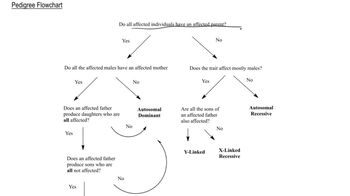
Pedigree analysis involves studying family trees to track the inheritance of specific traits across generations. By observing patterns of trait occurrence, geneticists can infer modes of inheritance such as dominant, recessive, or sex-linked without performing experimental crosses.
Recommended video:
Guided course
Pedigree Flowchart
Mendelian Inheritance Principles
Mendelian inheritance describes how traits are passed from parents to offspring through discrete units called genes. Understanding dominant and recessive alleles, segregation, and independent assortment helps explain trait transmission in humans despite the lack of controlled breeding experiments.
Recommended video:
Guided course
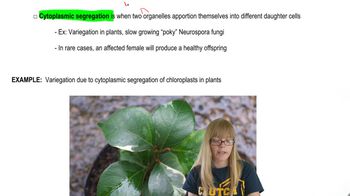
Organelle Inheritance
Molecular Genetics and DNA Analysis
Advances in molecular genetics allow scientists to study DNA sequences and identify mutations responsible for traits. Techniques like gene mapping and sequencing provide direct evidence of inheritance patterns and gene function in humans without experimental crosses.
Recommended video:
Guided course
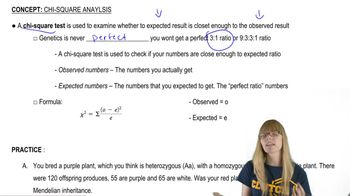
Chi Square Analysis
Related Videos
Related Practice
Multiple Choice
1196
views
2
rank