Pearson+ LogoPearson+ Logo
Ch. 11 - DNA Replication and Recombination
Klug - Concepts of Genetics  12th Edition
Klug12th EditionConcepts of Genetics ISBN: 9780135564776Not the one you use?Change textbook
Chapter 11, Problem 22

Describe the 'end-replication problem' in eukaryotes. How is it resolved?

Verified step by step guidance
1
Understand the 'end-replication problem': In eukaryotic cells, DNA replication occurs in a semi-conservative manner, where the DNA polymerase enzyme synthesizes new strands. However, DNA polymerase cannot fully replicate the ends of linear chromosomes (telomeres) because it requires a primer to initiate synthesis and cannot fill in the gap left after the removal of the RNA primer at the 5' end of the lagging strand.
Recognize the consequences of the problem: Due to the inability to replicate the very ends of chromosomes, telomeres progressively shorten with each cell division. This shortening can lead to loss of essential genetic information and cellular aging (senescence).
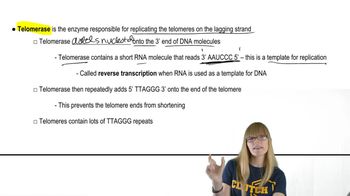
Learn how eukaryotic cells resolve the problem: Eukaryotic cells use an enzyme called telomerase to counteract telomere shortening. Telomerase is a ribonucleoprotein that contains an RNA template complementary to the telomeric DNA sequence. It extends the 3' end of the chromosome by adding repetitive nucleotide sequences.
Understand the mechanism of telomerase action: Telomerase binds to the overhanging 3' end of the telomere and uses its RNA template to synthesize additional telomeric repeats. This extension provides a template for the lagging strand synthesis, ensuring that the chromosome ends are fully replicated.
Explore the biological significance: Telomerase activity is high in germ cells, stem cells, and certain cancer cells, allowing them to maintain telomere length and divide indefinitely. In contrast, most somatic cells have low telomerase activity, leading to gradual telomere shortening and limited cell division capacity.

Verified video answer for a similar problem:

This video solution was recommended by our tutors as helpful for the problem above.
Video duration:
1m
Was this helpful?

Key Concepts

Here are the essential concepts you must grasp in order to answer the question correctly.

End-Replication Problem

The end-replication problem refers to the difficulty eukaryotic cells face in fully replicating their linear chromosomes during cell division. DNA polymerase, the enzyme responsible for DNA synthesis, cannot completely replicate the ends of linear DNA molecules due to its inability to initiate synthesis without a primer. This results in the progressive shortening of chromosomes with each cell division, which can lead to genomic instability.
Recommended video:
Guided course
14:31
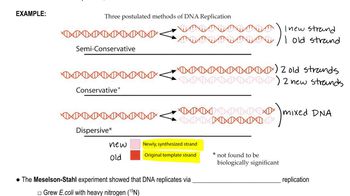
Semiconservative Replication

Telomeres

Telomeres are repetitive nucleotide sequences located at the ends of eukaryotic chromosomes that protect them from degradation and prevent the loss of essential genetic information during DNA replication. They act as a buffer zone, ensuring that the coding regions of the DNA are not affected by the end-replication problem. Over time, telomeres shorten with each cell division, which is associated with aging and cellular senescence.
Recommended video:
Guided course
08:38
Telomeres and Telomerase

Telomerase

Telomerase is an enzyme that adds repetitive nucleotide sequences to the ends of telomeres, counteracting the end-replication problem. It is composed of a protein component and an RNA template that guides the addition of telomeric repeats. Telomerase is active in certain cell types, such as stem cells and germ cells, allowing them to maintain telomere length and continue dividing, which is crucial for tissue regeneration and development.
Recommended video:
Guided course
08:38
Telomeres and Telomerase
Related Practice
Textbook Question

Several temperature-sensitive mutant strains of E. coli display the following characteristics. Predict what enzyme or function is being affected by each mutation.

Synthesis is very slow.

651
views
Textbook Question

Several temperature-sensitive mutant strains of E. coli display the following characteristics. Predict what enzyme or function is being affected by each mutation.

Supercoiled strands remain after replication, which is never completed.

705
views
Textbook Question

While many commonly used antibiotics interfere with protein synthesis or cell wall formation, clorobiocin, one of several antibiotics in the aminocoumarin class, inhibits the activity of bacterial DNA gyrase. Similar drugs have been tested as treatments for human cancer. How might such drugs be effective against bacteria as well as cancer?

557
views
Textbook Question

Many of the gene products involved in DNA synthesis were initially defined by studying mutant E. coli strains that could not synthesize DNA.

The dnaE gene encodes the α subunit of DNA polymerase III. What effect is expected from a mutation in this gene? How could the mutant strain be maintained?

613
views
Textbook Question

Many of the gene products involved in DNA synthesis were initially defined by studying mutant E. coli strains that could not synthesize DNA.

The dnaQ gene encodes the ε subunit of DNA polymerase. What effect is expected from a mutation in this gene?

489
views
Textbook Question

In 1994, telomerase activity was discovered in human cancer cell lines. Although telomerase is not active in most human adult cells, all cells do contain the genes for telomerase proteins and telomerase RNA. Since inappropriate activation of telomerase may contribute to cancer, why do you think the genes coding for this enzyme have been maintained in the human genome throughout evolution? Are there any types of human body cells where telomerase activation would be advantageous or even necessary? Explain.

739
views