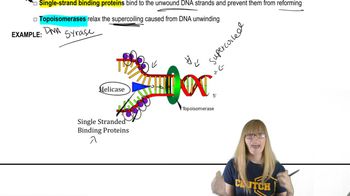
While many commonly used antibiotics interfere with protein synthesis or cell wall formation, clorobiocin, one of several antibiotics in the aminocoumarin class, inhibits the activity of bacterial DNA gyrase. Similar drugs have been tested as treatments for human cancer. How might such drugs be effective against bacteria as well as cancer?

Many of the gene products involved in DNA synthesis were initially defined by studying mutant E. coli strains that could not synthesize DNA.
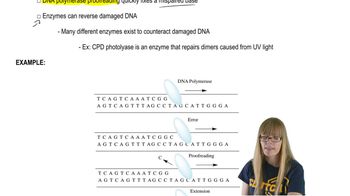
The dnaQ gene encodes the ε subunit of DNA polymerase. What effect is expected from a mutation in this gene?
Verified step by step guidance
Verified video answer for a similar problem:
Key Concepts
Role of DNA Polymerase in DNA Synthesis
Function of the ε Subunit (dnaQ Gene Product)
Effects of Mutations in dnaQ on DNA Replication
Describe the 'end-replication problem' in eukaryotes. How is it resolved?
Many of the gene products involved in DNA synthesis were initially defined by studying mutant E. coli strains that could not synthesize DNA.
The dnaE gene encodes the α subunit of DNA polymerase III. What effect is expected from a mutation in this gene? How could the mutant strain be maintained?
In 1994, telomerase activity was discovered in human cancer cell lines. Although telomerase is not active in most human adult cells, all cells do contain the genes for telomerase proteins and telomerase RNA. Since inappropriate activation of telomerase may contribute to cancer, why do you think the genes coding for this enzyme have been maintained in the human genome throughout evolution? Are there any types of human body cells where telomerase activation would be advantageous or even necessary? Explain.
The genome of D. melanogaster consists of approximately 1.7x10⁸ base pairs. DNA synthesis occurs at a rate of 30 base pairs per second. In the early embryo, the entire genome is replicated in five minutes. How many bidirectional origins of synthesis are required to accomplish this feat?
Assume a hypothetical organism in which DNA replication is conservative. Design an experiment similar to that of Taylor, Woods, and Hughes that will unequivocally establish this fact. Using the format established in Figure 11.5, draw sister chromatids and illustrate the expected results establishing this mode of replication.
