Pearson+ LogoPearson+ Logo
Ch. 11 - DNA Replication and Recombination
Klug - Concepts of Genetics  12th Edition
Klug12th EditionConcepts of Genetics ISBN: 9780135564776Not the one you use?Change textbook
Chapter 11, Problem 23a

Many of the gene products involved in DNA synthesis were initially defined by studying mutant E. coli strains that could not synthesize DNA.
The dnaE gene encodes the α subunit of DNA polymerase III. What effect is expected from a mutation in this gene? How could the mutant strain be maintained?

Verified step by step guidance
1
Understand the role of the dnaE gene: It encodes the α subunit of DNA polymerase III, which is the main enzyme responsible for the synthesis of the leading and lagging DNA strands during replication in E. coli.
Predict the effect of a mutation in dnaE: Since the α subunit has the polymerase activity, a mutation that disrupts its function would likely impair or completely block DNA synthesis, leading to a lethal phenotype because the cell cannot replicate its DNA.
Consider how the mutant strain could be maintained despite the lethal effect: One common method is to provide a functional copy of the dnaE gene on a plasmid (a small, circular DNA molecule) that complements the defective chromosomal gene, allowing the cell to survive and replicate.
Alternatively, maintain the mutant strain under permissive conditions if the mutation is temperature-sensitive, meaning the mutant protein functions at a lower (permissive) temperature but not at a higher (restrictive) temperature.
Summarize that the mutation in dnaE causes defective DNA replication, and the mutant strain can be maintained by genetic complementation or conditional growth conditions that allow survival despite the mutation.

Verified video answer for a similar problem:

This video solution was recommended by our tutors as helpful for the problem above.
Video duration:
1m
Was this helpful?

Key Concepts

Here are the essential concepts you must grasp in order to answer the question correctly.

Role of DNA Polymerase III in DNA Synthesis

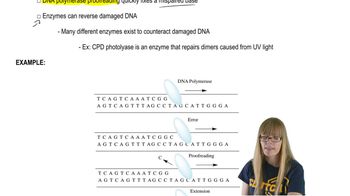
DNA polymerase III is the primary enzyme responsible for bacterial DNA replication, synthesizing the new DNA strand by adding nucleotides complementary to the template. The α subunit, encoded by dnaE, carries the polymerase activity essential for chain elongation. A mutation in dnaE can impair DNA replication, leading to defective or halted DNA synthesis.
Recommended video:
Guided course
01:45
DNA Proofreading

Effects of Mutations in Essential Genes

Mutations in essential genes like dnaE often result in lethal or severely growth-impaired phenotypes because the gene product is critical for survival. Such mutations can cause loss of function or dominant negative effects, preventing normal cellular processes like DNA replication, which is vital for cell division and viability.
Recommended video:
Guided course
03:38
Maternal Effect

Maintenance of Mutant Strains via Complementation or Conditional Mutations

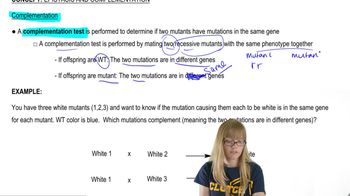
Mutant strains with lethal mutations can be maintained using complementation with a plasmid carrying the wild-type gene or by using conditional mutations (e.g., temperature-sensitive alleles) that allow normal function under permissive conditions. This enables growth and study of mutants under controlled environments despite the essential gene defect.
Recommended video:
Guided course
05:05
Complementation
Related Practice
Textbook Question

Several temperature-sensitive mutant strains of E. coli display the following characteristics. Predict what enzyme or function is being affected by each mutation.

Supercoiled strands remain after replication, which is never completed.

705
views
Textbook Question

While many commonly used antibiotics interfere with protein synthesis or cell wall formation, clorobiocin, one of several antibiotics in the aminocoumarin class, inhibits the activity of bacterial DNA gyrase. Similar drugs have been tested as treatments for human cancer. How might such drugs be effective against bacteria as well as cancer?

557
views
Textbook Question

Describe the 'end-replication problem' in eukaryotes. How is it resolved?

941
views
Textbook Question

Many of the gene products involved in DNA synthesis were initially defined by studying mutant E. coli strains that could not synthesize DNA.

The dnaQ gene encodes the ε subunit of DNA polymerase. What effect is expected from a mutation in this gene?

489
views
Textbook Question

In 1994, telomerase activity was discovered in human cancer cell lines. Although telomerase is not active in most human adult cells, all cells do contain the genes for telomerase proteins and telomerase RNA. Since inappropriate activation of telomerase may contribute to cancer, why do you think the genes coding for this enzyme have been maintained in the human genome throughout evolution? Are there any types of human body cells where telomerase activation would be advantageous or even necessary? Explain.

739
views
Textbook Question

The genome of D. melanogaster consists of approximately 1.7x10⁸ base pairs. DNA synthesis occurs at a rate of 30 base pairs per second. In the early embryo, the entire genome is replicated in five minutes. How many bidirectional origins of synthesis are required to accomplish this feat?

624
views