Which of the following methods is used to study protein-DNA interactions?
Table of contents
- 1. Introduction to Genetics51m
- 2. Mendel's Laws of Inheritance3h 37m
- 3. Extensions to Mendelian Inheritance2h 41m
- 4. Genetic Mapping and Linkage2h 28m
- 5. Genetics of Bacteria and Viruses1h 21m
- 6. Chromosomal Variation1h 48m
- 7. DNA and Chromosome Structure56m
- 8. DNA Replication1h 10m
- 9. Mitosis and Meiosis1h 34m
- 10. Transcription1h 0m
- 11. Translation58m
- 12. Gene Regulation in Prokaryotes1h 19m
- 13. Gene Regulation in Eukaryotes44m
- 14. Genetic Control of Development44m
- 15. Genomes and Genomics1h 50m
- 16. Transposable Elements47m
- 17. Mutation, Repair, and Recombination1h 6m
- 18. Molecular Genetic Tools19m
- 19. Cancer Genetics29m
- 20. Quantitative Genetics1h 26m
- 21. Population Genetics50m
- 22. Evolutionary Genetics29m
15. Genomes and Genomics
Functional Genomics
Problem 3
Textbook Question
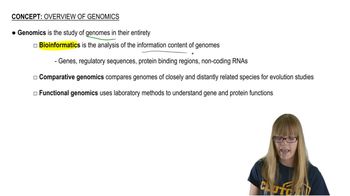
What is functional genomics? How does it differ from comparative genomics?
Verified step by step guidance1
Step 1: Define functional genomics by explaining that it is the branch of genomics focused on understanding the dynamic aspects of gene function and interaction, including how genes and proteins work together to influence biological processes.
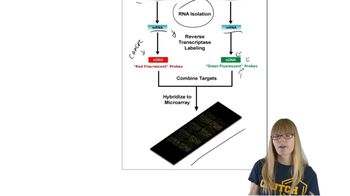
Step 2: Describe the main goal of functional genomics, which is to determine the roles and functions of genes and non-coding regions in the genome, often using techniques like transcriptomics, proteomics, and gene knockout studies.
Step 3: Define comparative genomics as the study of comparing the genomes of different species to identify similarities and differences in gene content, structure, and organization.
Step 4: Explain that comparative genomics aims to understand evolutionary relationships, identify conserved genes, and infer gene function based on conservation across species.
Step 5: Summarize the key difference by stating that functional genomics focuses on the activity and function of genes within an organism, while comparative genomics focuses on comparing genomes across species to understand evolutionary and functional relationships.
Verified video answer for a similar problem:This video solution was recommended by our tutors as helpful for the problem above
Video duration:
1mPlay a video:
Was this helpful?
Key Concepts
Here are the essential concepts you must grasp in order to answer the question correctly.
Functional Genomics
Functional genomics studies the roles and interactions of genes and proteins within a genome, focusing on understanding gene expression, regulation, and function. It uses techniques like transcriptomics and proteomics to link genetic information to biological activity.
Recommended video:
Guided course
Functional Genomics
Comparative Genomics
Comparative genomics involves comparing the genomes of different species to identify similarities and differences. This approach helps reveal evolutionary relationships, conserved genes, and species-specific adaptations by analyzing genome structure and sequence.
Recommended video:
Guided course
Genomics Overview
Differences Between Functional and Comparative Genomics
While functional genomics focuses on understanding gene functions within a single organism, comparative genomics compares genomes across species to study evolutionary patterns. Functional genomics is experimental and dynamic, whereas comparative genomics is analytical and evolutionary.
Recommended video:
Guided course
Functional Genomics
Related Videos
Related Practice
Multiple Choice
644
views
2
rank