Pearson+ LogoPearson+ Logo
Ch. 1 - Introduction to Genetics
Klug - Concepts of Genetics  12th Edition
Klug12th EditionConcepts of Genetics ISBN: 9780135564776Not the one you use?Change textbook
Chapter 1, Problem 10

Outline the roles played by restriction enzymes and vectors in cloning DNA.

Verified step by step guidance
1
Understand that restriction enzymes, also known as restriction endonucleases, act as molecular scissors that recognize specific DNA sequences and cut the DNA at or near these sites. This allows scientists to cut DNA into manageable fragments for cloning.
Recognize that vectors are DNA molecules used as carriers to transfer foreign genetic material into a host cell. Common vectors include plasmids, bacteriophages, and cosmids.
Learn that after the restriction enzyme cuts both the DNA fragment of interest and the vector DNA with compatible ends, these fragments can be joined together using an enzyme called DNA ligase, forming recombinant DNA.
Know that the recombinant vector is then introduced into a host organism (usually bacteria) through a process called transformation, where the host cells take up the recombinant DNA and replicate it, producing many copies of the inserted gene.
Appreciate that the combined action of restriction enzymes and vectors enables the precise insertion and propagation of specific DNA sequences, which is fundamental for gene cloning, genetic engineering, and molecular biology research.

Verified video answer for a similar problem:

This video solution was recommended by our tutors as helpful for the problem above.
Video duration:
37s
Was this helpful?

Key Concepts

Here are the essential concepts you must grasp in order to answer the question correctly.

Restriction Enzymes

Restriction enzymes are proteins that cut DNA at specific sequences, known as recognition sites. They act as molecular scissors, enabling scientists to cut DNA into precise fragments for cloning. These enzymes are essential for isolating the gene or DNA segment of interest.
Recommended video:
Guided course
07:11
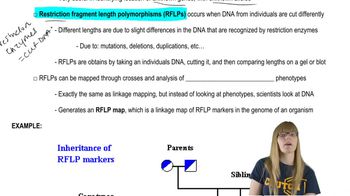
Mapping with Markers

Vectors

Vectors are DNA molecules used to carry foreign DNA into a host cell during cloning. Common vectors include plasmids and viruses, which can replicate independently within the host, ensuring the inserted DNA is copied and expressed.
Recommended video:
Guided course
04:17
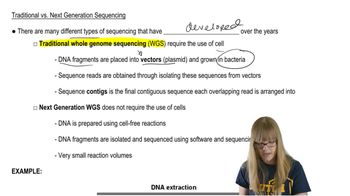
Traditional vs. Next-Gen

DNA Cloning Process

DNA cloning involves inserting a DNA fragment into a vector using restriction enzymes, then introducing this recombinant DNA into a host cell. The host replicates the vector, producing multiple copies of the DNA fragment for further study or use.
Recommended video:
Guided course
07:39
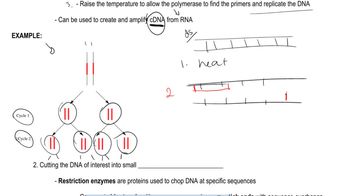
Genetic Cloning