
Textbook Question
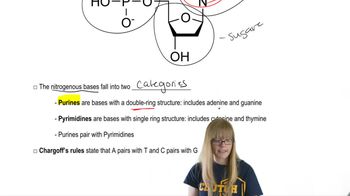
What did the Watson–Crick model suggest about the replication of DNA?
1226
views

 Verified step by step guidance
 06:25
06:25
 03:38
03:38 02:48
02:48What did the Watson–Crick model suggest about the replication of DNA?
One of the most common spontaneous lesions that occurs in DNA under physiological conditions is the hydrolysis of the amino group of cytosine, converting the cytosine to uracil. What would be the effect on DNA structure of a uracil group replacing cytosine?
A genetics student was asked to draw the chemical structure of an adenine- and thymine-containing dinucleotide derived from DNA. The answer is shown here:
The student made more than six major errors. One of them is circled, numbered 1, and explained. Find five others. Circle them, number them 2 through 6, and briefly explain each in the manner of the example given.
Because of its rapid turnaround time, fluorescent in situ hybridization (FISH) is commonly used in hospitals and laboratories as an aneuploid screen of cells retrieved from amniocentesis and chorionic villus sampling (CVS). Chromosomes 13, 18, 21, X, and Y are typically screened for aneuploidy in this way. Explain how FISH might be accomplished using amniotic or CVS samples and why the above chromosomes have been chosen for screening.
What is the chemical basis of molecular hybridization?
In some organisms, cytosine is methylated at carbon 5 of the pyrimidine ring after it is incorporated into DNA. If a 5-methyl cytosine molecule is then hydrolyzed, what base will be generated?