Pearson+ LogoPearson+ Logo
Ch. 10 - DNA Structure and Analysis
Klug - Concepts of Genetics  12th Edition
Klug12th EditionConcepts of Genetics ISBN: 9780135564776Not the one you use?Change textbook
Chapter 10, Problem 24

What is the chemical basis of molecular hybridization?

Verified step by step guidance
1
Understand that molecular hybridization refers to the process where two complementary strands of nucleic acids (DNA or RNA) form a double-stranded molecule by base pairing.
Recognize that the chemical basis of this process lies in the specific hydrogen bonding between complementary nitrogenous bases: adenine (A) pairs with thymine (T) in DNA or uracil (U) in RNA, and cytosine (C) pairs with guanine (G).
Recall that adenine and thymine/uracil form two hydrogen bonds, while cytosine and guanine form three hydrogen bonds, which stabilize the hybridized structure.
Note that the hybridization process depends on the complementarity and the ability of these bases to form hydrogen bonds, allowing the strands to anneal or re-anneal after denaturation.
Summarize that the chemical basis of molecular hybridization is the formation of specific hydrogen bonds between complementary nucleobases, enabling the pairing and stability of nucleic acid strands.

Verified video answer for a similar problem:

This video solution was recommended by our tutors as helpful for the problem above.
Video duration:
1m
Was this helpful?

Key Concepts

Here are the essential concepts you must grasp in order to answer the question correctly.

Base Pairing Rules

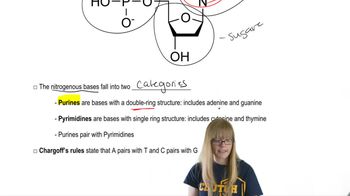
Molecular hybridization relies on the specific pairing between complementary nucleotides: adenine pairs with thymine (or uracil in RNA), and cytosine pairs with guanine. This specificity is due to hydrogen bonding patterns, which enable strands of nucleic acids to recognize and bind to each other accurately.
Recommended video:
Guided course
03:49
Base Distortions

Hydrogen Bonding

Hydrogen bonds are weak, non-covalent interactions that form between complementary bases in nucleic acids. These bonds stabilize the hybridized double-stranded structure, allowing single strands of DNA or RNA to anneal based on sequence complementarity.
Recommended video:
Guided course
06:25
DNA Structure

Nucleic Acid Structure

The chemical structure of nucleic acids, including the sugar-phosphate backbone and nitrogenous bases, facilitates hybridization. The linear arrangement and polarity of strands allow complementary sequences to align antiparallel and form stable duplexes through base pairing.
Recommended video:
Guided course
03:49
Ribosome Structure