Pearson+ LogoPearson+ Logo
Ch. 10 - DNA Structure and Analysis
Klug - Concepts of Genetics  12th Edition
Klug12th EditionConcepts of Genetics ISBN: 9780135564776Not the one you use?Change textbook
Chapter 10, Problem 26

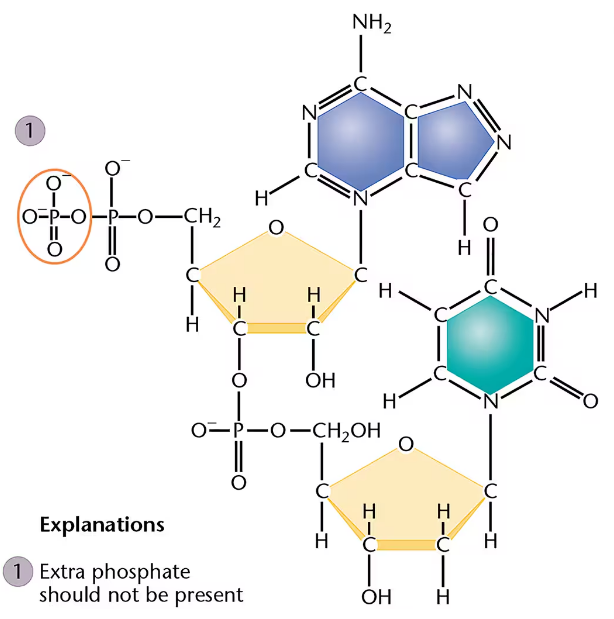
A genetics student was asked to draw the chemical structure of an adenine- and thymine-containing dinucleotide derived from DNA. The answer is shown here:
Chemical structure of an adenine-thymine dinucleotide with six major errors, one circled and explained as an extra phosphate.
The student made more than six major errors. One of them is circled, numbered 1, and explained. Find five others. Circle them, number them 2 through 6, and briefly explain each in the manner of the example given.

Verified step by step guidance
1
Identify the sugar-phosphate backbone and the bases adenine and thymine in the dinucleotide structure. Recall that DNA nucleotides consist of a deoxyribose sugar, a phosphate group, and a nitrogenous base (adenine or thymine here).
Look for the first error beyond the extra phosphate (already circled as error 1). Check the sugar rings: DNA sugars are deoxyribose, which means the 2' carbon should have a hydrogen (H) instead of a hydroxyl group (OH). If the sugar has an OH at the 2' position, this is an error.
Examine the glycosidic bonds between the sugar and the bases. The bond should be between the 1' carbon of the sugar and the nitrogen atom of the base (N9 for purines like adenine, N1 for pyrimidines like thymine). If the bond is misplaced or missing, mark it as an error.
Check the phosphate linkage between the two nucleotides. The phosphate group should connect the 3' carbon of the first sugar to the 5' carbon of the second sugar. If the phosphate is attached incorrectly (e.g., to the wrong carbon), this is an error.
Inspect the base pairing and hydrogen atoms on the bases. For example, thymine should have a methyl group at the 5 position and proper keto groups. If any atoms are missing or incorrectly placed on the bases, note these as errors.
Verify the overall charge and ionization states of the phosphate groups. Phosphates in DNA are typically negatively charged (O⁻) at physiological pH. If the charges are missing or incorrect, this is an error.

Verified video answer for a similar problem:

This video solution was recommended by our tutors as helpful for the problem above.
Video duration:
1m
Was this helpful?

Key Concepts

Here are the essential concepts you must grasp in order to answer the question correctly.

Nucleotide Structure

A nucleotide consists of three components: a nitrogenous base, a five-carbon sugar (deoxyribose in DNA), and a phosphate group. The sugar and phosphate form the backbone, while the base attaches to the sugar's 1' carbon. Understanding the correct bonding and orientation of these parts is essential for identifying structural errors.
Recommended video:
Guided course
06:25
DNA Structure

Phosphodiester Bond Formation

In DNA, nucleotides are linked by phosphodiester bonds between the 3' hydroxyl group of one sugar and the 5' phosphate of the next. This linkage forms the sugar-phosphate backbone. Recognizing the correct number and placement of phosphate groups and their bonds is crucial to avoid errors like extra phosphates or incorrect linkages.
Recommended video:
Guided course
04:06
Formation of Plant Gametes

Base Pairing and Orientation

Adenine (A) pairs with thymine (T) via two hydrogen bonds in DNA. Each base must be attached to the sugar at the correct nitrogen atom (N9 for purines like adenine, N1 for pyrimidines like thymine). Correct orientation and attachment points ensure proper base pairing and molecular stability.
Recommended video:
Guided course
03:49
Base Distortions