Pearson+ LogoPearson+ Logo
Ch. 11 - DNA Replication and Recombination
Klug - Concepts of Genetics  12th Edition
Klug12th EditionConcepts of Genetics ISBN: 9780135564776Not the one you use?Change textbook
Chapter 11, Problem 6

What are the requirements for in vitro synthesis of DNA under the direction of DNA polymerase I?

Verified step by step guidance
1
Understand that DNA polymerase I requires a template strand of DNA to guide the synthesis of the new DNA strand, so the first requirement is a single-stranded DNA template.
Recognize that DNA polymerase I cannot initiate DNA synthesis de novo; it needs a primer with a free 3'-OH group to add nucleotides, so a primer annealed to the template is necessary.
Provide the four deoxyribonucleotide triphosphates (dNTPs): dATP, dTTP, dGTP, and dCTP, which serve as the building blocks for the new DNA strand.
Include the DNA polymerase I enzyme itself, which catalyzes the polymerization reaction by adding nucleotides to the primer in the 5' to 3' direction.
Ensure the reaction mixture contains an appropriate buffer with Mg^{2+} ions, as these are essential cofactors for the enzymatic activity of DNA polymerase I.

Verified video answer for a similar problem:

This video solution was recommended by our tutors as helpful for the problem above.
Video duration:
1m
Was this helpful?

Key Concepts

Here are the essential concepts you must grasp in order to answer the question correctly.

Role of DNA Polymerase I

DNA Polymerase I is an enzyme that synthesizes DNA by adding nucleotides to a pre-existing strand. It requires a template strand to guide the sequence and can also remove RNA primers through its exonuclease activity, making it essential for DNA replication and repair.
Recommended video:
Guided course
01:45
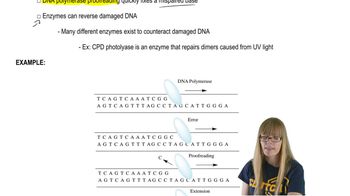
DNA Proofreading

Requirements for DNA Synthesis

In vitro DNA synthesis by DNA Polymerase I requires a single-stranded DNA template, a primer with a free 3'-OH group to initiate synthesis, all four deoxynucleotide triphosphates (dNTPs) as substrates, and appropriate buffer conditions including Mg2+ ions for enzyme activity.
Recommended video:
Guided course
02:43
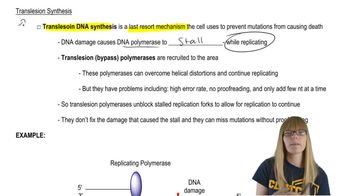
Translesion Synthesis

Primer-Template Structure

DNA Polymerase I cannot start DNA synthesis de novo; it needs a primer annealed to the template strand. The primer provides the free 3'-OH end necessary for the enzyme to add nucleotides, ensuring accurate and efficient DNA elongation.
Recommended video:
Guided course
03:49
Ribosome Structure