Pearson+ LogoPearson+ Logo
Ch. 13 - The Genetic Code and Transcription
Klug - Concepts of Genetics  12th Edition
Klug12th EditionConcepts of Genetics ISBN: 9780135564776Not the one you use?Change textbook
Chapter 13, Problem 18

What observations suggested the existence of mRNA?

Verified step by step guidance
1
Identify the role of mRNA in the central dogma of molecular biology, which describes the flow of genetic information from DNA to RNA to protein.
Consider the experiments that demonstrated the presence of an intermediate molecule that carries genetic information from DNA in the nucleus to the ribosomes in the cytoplasm, where protein synthesis occurs.
Review the pulse-chase experiments using radioactive labeling, which showed that RNA is synthesized in the nucleus and then moves to the cytoplasm, suggesting the existence of a messenger RNA.
Examine the discovery of RNA polymerase, the enzyme responsible for transcribing DNA into RNA, which provided further evidence for the existence of mRNA.
Understand the role of mRNA in translating the genetic code into proteins, as it serves as a template for assembling amino acids in the correct sequence during protein synthesis.

Verified video answer for a similar problem:

This video solution was recommended by our tutors as helpful for the problem above.
Video duration:
1m
Was this helpful?

Key Concepts

Here are the essential concepts you must grasp in order to answer the question correctly.

Messenger RNA (mRNA)

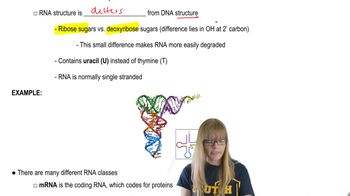
Messenger RNA (mRNA) is a type of RNA that conveys genetic information from DNA to the ribosome, where proteins are synthesized. It serves as a template for translating the genetic code into amino acids, which are the building blocks of proteins. The discovery of mRNA was pivotal in understanding how genes are expressed and regulated within cells.
Recommended video:

Transcription

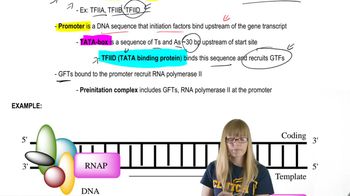
Transcription is the process by which the genetic information in DNA is copied into mRNA. This occurs in the nucleus of eukaryotic cells, where RNA polymerase binds to the DNA and synthesizes a complementary RNA strand. Observations of RNA synthesis during gene expression provided early evidence for the existence of mRNA.
Recommended video:
Guided course
09:16
Eukaryotic Transcription

Experimental Evidence

Experimental evidence for the existence of mRNA came from various studies, including the use of pulse-chase experiments and the identification of RNA in the cytoplasm that was distinct from DNA. These experiments demonstrated that RNA molecules were synthesized in the nucleus and then transported to the cytoplasm, where they played a crucial role in protein synthesis, supporting the concept of mRNA.
Recommended video:
Guided course
05:48
Transformation