Pearson+ LogoPearson+ Logo
Ch. 13 - The Genetic Code and Transcription
Klug - Concepts of Genetics  12th Edition
Klug12th EditionConcepts of Genetics ISBN: 9780135564776Not the one you use?Change textbook
Chapter 13, Problem 1b

What experimental evidence provided the initial insights into the compositions of codons encoding specific amino acids?

Verified step by step guidance
1
Understand that the question asks about the experimental evidence that first revealed how codons correspond to specific amino acids in the genetic code.
Recall that the key early experiments involved deciphering the genetic code by determining which sequences of nucleotides (codons) specify particular amino acids during protein synthesis.
Focus on the experiments by Marshall Nirenberg and Heinrich Matthaei in 1961, where they used synthetic RNA sequences in a cell-free system to direct the synthesis of polypeptides.
Note that they created artificial RNA sequences composed of repeating nucleotides, such as poly-U (uracil), and observed which amino acids were incorporated into the resulting polypeptides, linking specific codons to amino acids.
Recognize that this approach of using synthetic RNA and cell-free translation systems provided the first direct experimental evidence connecting codons to their corresponding amino acids.

Verified video answer for a similar problem:

This video solution was recommended by our tutors as helpful for the problem above.
Video duration:
2m
Was this helpful?

Key Concepts

Here are the essential concepts you must grasp in order to answer the question correctly.

The Genetic Code and Codons

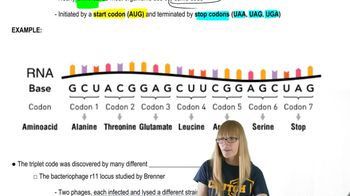
The genetic code consists of codons, which are sequences of three nucleotides in mRNA that specify particular amino acids during protein synthesis. Understanding that codons are triplets is fundamental to linking nucleotide sequences to amino acid sequences.
Recommended video:
Guided course
11:43
The Genetic Code

Nirenberg and Matthaei's Poly-U Experiment

This landmark experiment used synthetic RNA composed solely of uracil bases (poly-U) to direct protein synthesis in vitro, resulting in a polypeptide of phenylalanine. It provided the first direct evidence that specific codons correspond to specific amino acids.
Recommended video:
Guided course
05:48
Mendel's Laws

In Vitro Translation Systems

In vitro translation systems allow researchers to study protein synthesis outside living cells by providing mRNA templates and necessary components. These systems were crucial for testing synthetic RNAs and identifying which amino acids were incorporated, revealing codon assignments.
Recommended video:
Guided course
07:58
Translation initiation