Pearson+ LogoPearson+ Logo
Ch. 13 - The Genetic Code and Transcription
Klug - Concepts of Genetics  12th Edition
Klug12th EditionConcepts of Genetics ISBN: 9780135564776Not the one you use?Change textbook
Chapter 13, Problem 26a

It has been suggested that the present-day triplet genetic code evolved from a doublet code when there were fewer amino acids available for primitive protein synthesis.
Can you find any support for the doublet code notion in the existing coding dictionary?

Verified step by step guidance
1
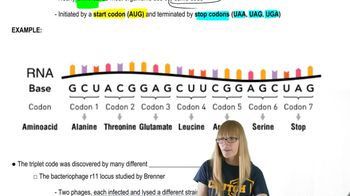
Examine the genetic code table to identify patterns in codon assignments. The genetic code consists of triplet codons, each made up of three nucleotides, which correspond to specific amino acids or stop signals.
Focus on the first two nucleotides of each codon in the table. Analyze whether these two nucleotides alone are sufficient to predict the amino acid or functional group (e.g., hydrophobic, polar, acidic) associated with the codon.
Group codons based on their first two nucleotides and observe if codons with the same first two nucleotides tend to encode similar amino acids or share functional properties. This could suggest a simpler doublet code origin.
Consider the evolutionary implications: If the first two nucleotides of codons show strong predictive power for amino acid assignment, it may indicate that the genetic code initially operated with fewer amino acids and a simpler doublet system before expanding to the triplet code.
Evaluate exceptions and ambiguities in the coding dictionary. Identify codons where the third nucleotide significantly alters the amino acid assignment, as these may represent later evolutionary refinements to the genetic code.

Verified video answer for a similar problem:

This video solution was recommended by our tutors as helpful for the problem above.
Video duration:
1m
Was this helpful?

Key Concepts

Here are the essential concepts you must grasp in order to answer the question correctly.

Genetic Code

The genetic code is a set of rules that defines how the sequence of nucleotides in DNA or RNA is translated into the sequence of amino acids in proteins. It is composed of codons, which are triplets of nucleotides. Understanding the genetic code is essential for exploring how proteins are synthesized and how variations in the code can lead to different proteins.
Recommended video:
Guided course
11:43
The Genetic Code

Doublet Code

The doublet code refers to a hypothetical early form of the genetic code that utilized pairs of nucleotides (dinucleotides) to encode amino acids, as opposed to the triplet codons used in the modern genetic code. This concept suggests that the genetic coding system may have evolved from simpler forms, which could provide insights into the origins of protein synthesis and the evolution of genetic complexity.
Recommended video:
Guided course
11:43
The Genetic Code

Amino Acid Availability

Amino acid availability refers to the presence and abundance of different amino acids in the primordial environment, which would have influenced the early stages of protein synthesis. The hypothesis that the genetic code evolved from a doublet code is supported by the idea that fewer amino acids were available in the early Earth, necessitating a simpler coding system for protein synthesis before the complexity of the triplet code emerged.
Recommended video:
Guided course
02:33
Trp Repressor
Related Practice
Textbook Question

One form of posttranscriptional modification of most eukaryotic pre-mRNAs is the addition of a poly-A sequence at the 3' end. The absence of a poly-A sequence leads to rapid degradation of the transcript. Poly-A sequences of various lengths are also added to many bacterial RNA transcripts where, instead of promoting stability, they enhance degradation. In both cases, RNA secondary structures, stabilizing proteins, or degrading enzymes interact with poly-A sequences. Considering the activities of RNAs, what might be general functions of 3'-polyadenylation?

567
views
Textbook Question

Describe the role of two forms of RNA editing that lead to changes in the size and sequence of pre-mRNAs. Briefly describe several examples of each form of editing, including their impact on respective protein products.

524
views
Textbook Question

Substitution RNA editing is known to involve either C-to-U or A-to-I conversions. What common chemical event accounts for each?

589
views
Textbook Question

It has been suggested that the present-day triplet genetic code evolved from a doublet code when there were fewer amino acids available for primitive protein synthesis.

The amino acids Ala, Val, Gly, Asp, and Glu are all early members of biosynthetic pathways and are more evolutionarily conserved than other amino acids. They therefore probably represent 'early' amino acids. Of what significance is this information in terms of the evolution of the genetic code? Also, which base, of the first two within a coding triplet, would likely have been the more significant in originally specifying these amino acids?

630
views
Textbook Question

It has been suggested that the present-day triplet genetic code evolved from a doublet code when there were fewer amino acids available for primitive protein synthesis.

As determined by comparisons of ancient and recently evolved proteins, cysteine, tyrosine, and phenylalanine appear to be late-arriving amino acids. In addition, they are considered to have been absent in the abiotic Earth. All three of these amino acids have only two codons each, while many others, earlier in origin, have more. Is this mere coincidence, or might there be some underlying explanation?

845
views
Textbook Question

An early proposal by George Gamow in 1954 regarding the genetic code considered the possibility that DNA served directly as the template for polypeptide synthesis. In eukaryotes, what difficulties would such a system pose? What observations and theoretical considerations argue against such a proposal?

595
views