Pearson+ LogoPearson+ Logo
Ch. 13 - The Genetic Code and Transcription
Klug - Concepts of Genetics  12th Edition
Klug12th EditionConcepts of Genetics ISBN: 9780135564776Not the one you use?Change textbook
Chapter 13, Problem 27

An early proposal by George Gamow in 1954 regarding the genetic code considered the possibility that DNA served directly as the template for polypeptide synthesis. In eukaryotes, what difficulties would such a system pose? What observations and theoretical considerations argue against such a proposal?

Verified step by step guidance
1
Understand the proposal: George Gamow suggested that DNA directly serves as the template for polypeptide synthesis, meaning that the sequence of nucleotides in DNA would directly correspond to the sequence of amino acids in a protein.
Consider the structural differences between DNA and proteins: DNA is composed of four nucleotide bases (adenine, thymine, cytosine, and guanine), while proteins are composed of 20 different amino acids. This mismatch in diversity makes it unlikely for DNA to directly encode proteins without an intermediary mechanism.
Evaluate the spatial and functional separation in eukaryotic cells: In eukaryotes, DNA is located in the nucleus, while protein synthesis occurs in the cytoplasm at ribosomes. This physical separation would make direct translation of DNA into proteins impractical without an intermediary molecule like mRNA.
Examine the role of RNA: Observations show that RNA acts as an intermediary between DNA and protein synthesis. Messenger RNA (mRNA) is transcribed from DNA and then translated into proteins in the cytoplasm, supporting the idea of an indirect mechanism rather than direct DNA-to-protein synthesis.
Consider theoretical arguments: The genetic code is triplet-based (codons), and each codon corresponds to a specific amino acid. This system requires a decoding mechanism (e.g., tRNA and ribosomes) to translate nucleotide sequences into amino acid sequences, which would not be possible if DNA directly served as the template for protein synthesis.

Verified video answer for a similar problem:

This video solution was recommended by our tutors as helpful for the problem above.
Video duration:
55s
Was this helpful?

Key Concepts

Here are the essential concepts you must grasp in order to answer the question correctly.

Genetic Code

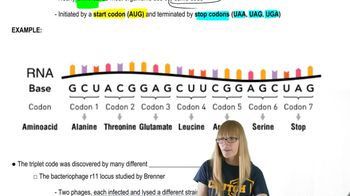
The genetic code is the set of rules by which information encoded in genetic material (DNA or RNA) is translated into proteins. It consists of codons, which are sequences of three nucleotides that correspond to specific amino acids. Understanding the genetic code is essential for grasping how genes dictate the synthesis of proteins, which are crucial for cellular function.
Recommended video:
Guided course
11:43
The Genetic Code

Eukaryotic Gene Expression

Eukaryotic gene expression involves multiple steps, including transcription in the nucleus and translation in the cytoplasm. This process is more complex than in prokaryotes due to the presence of introns, exons, and the need for mRNA processing. Recognizing these complexities is vital to understanding why a direct DNA-to-polypeptide synthesis model would face challenges in eukaryotic cells.
Recommended video:
Guided course
02:09
Penetrance and Expressivity

Transcription and Translation

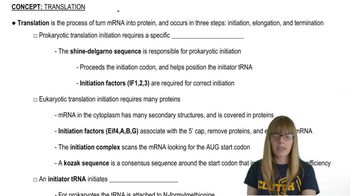
Transcription is the process by which DNA is copied into messenger RNA (mRNA), while translation is the subsequent process where ribosomes synthesize proteins based on the mRNA sequence. In eukaryotes, these processes are separated by the nuclear membrane, which complicates the idea of DNA directly serving as a template for protein synthesis, as it requires intermediary steps and cellular machinery.
Recommended video:
Guided course
07:58
Translation initiation
Related Practice
Textbook Question

It has been suggested that the present-day triplet genetic code evolved from a doublet code when there were fewer amino acids available for primitive protein synthesis.

Can you find any support for the doublet code notion in the existing coding dictionary?

620
views
Textbook Question

It has been suggested that the present-day triplet genetic code evolved from a doublet code when there were fewer amino acids available for primitive protein synthesis.

The amino acids Ala, Val, Gly, Asp, and Glu are all early members of biosynthetic pathways and are more evolutionarily conserved than other amino acids. They therefore probably represent 'early' amino acids. Of what significance is this information in terms of the evolution of the genetic code? Also, which base, of the first two within a coding triplet, would likely have been the more significant in originally specifying these amino acids?

630
views
Textbook Question

It has been suggested that the present-day triplet genetic code evolved from a doublet code when there were fewer amino acids available for primitive protein synthesis.

As determined by comparisons of ancient and recently evolved proteins, cysteine, tyrosine, and phenylalanine appear to be late-arriving amino acids. In addition, they are considered to have been absent in the abiotic Earth. All three of these amino acids have only two codons each, while many others, earlier in origin, have more. Is this mere coincidence, or might there be some underlying explanation?

845
views
Textbook Question

In a mixed copolymer experiment, messages were created with either 4/5C:1/5A or 4/5A:1/5C. These messages yielded proteins with the following amino acid compositions.

Using these data, predict the most specific coding composition for each amino acid.

929
views
Textbook Question

Shown here are the amino acid sequences of the wild-type and three mutant forms of a short protein.

___________________________________________________

Wild-type: Met-Trp-Tyr-Arg-Gly-Ser-Pro-Thr

Mutant 1: Met-Trp

Mutant 2: Met-Trp-His-Arg-Gly-Ser-Pro-Thr

Mutant 3: Met-Cys-Ile-Val-Val-Val-Gln-His                 _


Use this information to answer the following questions:

Using the genetic coding dictionary, predict the type of mutation that led to each altered protein.

1047
views
Textbook Question

Shown here are the amino acid sequences of the wild-type and three mutant forms of a short protein.

___________________________________________________

Wild-type: Met-Trp-Tyr-Arg-Gly-Ser-Pro-Thr

Mutant 1: Met-Trp

Mutant 2: Met-Trp-His-Arg-Gly-Ser-Pro-Thr

Mutant 3: Met-Cys-Ile-Val-Val-Val-Gln-Hi

___________________________________________________

Use this information to answer the following questions:

For each mutant protein, determine the specific ribonucleotide change that led to its synthesis.

478
views