Pearson+ LogoPearson+ Logo
Ch. 13 - The Genetic Code and Transcription
Klug - Concepts of Genetics  12th Edition
Klug12th EditionConcepts of Genetics ISBN: 9780135564776Not the one you use?Change textbook
Chapter 13, Problem 31c

M. Klemke et al. (2001) discovered an interesting coding phenomenon in which an exon within a neurologic hormone receptor gene in mammals appears to produce two different protein entities (and ALEX). The following is the DNA sequence of the exon's end derived from a rat.
 5'-gtcccaaccatgcccaccgatcttccgcctgcttctgaagATGCGGGCCCAG
The lowercase letters represent the initial coding portion for the protein, and the uppercase letters indicate the portion where the ALEX entity is initiated. (For simplicity, and to correspond with the RNA coding dictionary, it is customary to represent the coding (non-template) strand of the DNA segment.)
Locate the initiator codon within the ALEX segment. Are the two initiator codons in frame?

Verified step by step guidance
1
Step 1: Understand the problem. The DNA sequence provided contains two regions: one coding for the initial protein (lowercase letters) and another coding for the ALEX protein (uppercase letters). The task is to locate the initiator codon within the ALEX segment and determine if the two initiator codons are in frame.
Step 2: Recall the initiator codon. The initiator codon for translation is typically 'ATG', which codes for methionine. This codon signals the start of protein synthesis.
Step 3: Locate the 'ATG' codon in the uppercase portion of the DNA sequence. The uppercase portion begins with 'ATGCGGGCCCAG'. Identify the position of the 'ATG' codon within this segment.
Step 4: Determine the reading frame of the lowercase portion. To check if the two initiator codons are in frame, analyze the sequence of the lowercase letters and identify the position of the first 'ATG' codon. Compare its reading frame with the 'ATG' codon in the uppercase portion.
Step 5: Compare the frames. If the positions of the two 'ATG' codons align such that they are divisible by three (the length of a codon), then the two initiator codons are in frame. Otherwise, they are out of frame.

Verified video answer for a similar problem:

This video solution was recommended by our tutors as helpful for the problem above.
Video duration:
2m
Was this helpful?

Key Concepts

Here are the essential concepts you must grasp in order to answer the question correctly.

Exons and Introns

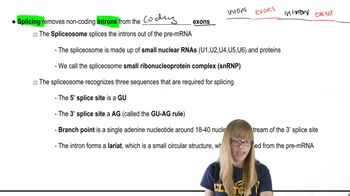
Exons are the coding regions of a gene that are expressed as proteins, while introns are non-coding regions that are spliced out during RNA processing. Understanding the distinction between exons and introns is crucial for analyzing gene structure and function, particularly in the context of alternative splicing, where different combinations of exons can lead to the production of multiple protein variants from a single gene.
Recommended video:
Guided course
08:39
mRNA Processing

Initiator Codon

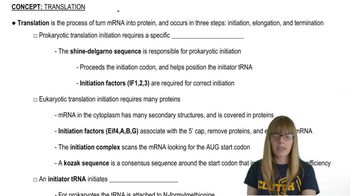
The initiator codon, typically AUG, is the specific sequence in mRNA that signals the start of translation, marking the site where ribosomes begin synthesizing proteins. Identifying the initiator codon is essential for understanding how proteins are translated from mRNA, especially when analyzing multiple protein products from a single gene, as in the case of the ALEX entity.
Recommended video:
Guided course
07:58
Translation initiation

Reading Frame

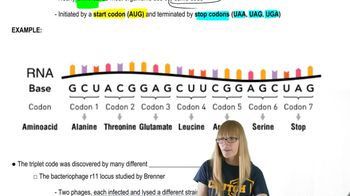
The reading frame refers to the way nucleotides in mRNA are grouped into codons, which are sets of three nucleotides that correspond to specific amino acids. For two initiator codons to be considered 'in frame,' they must align correctly within the same reading frame, ensuring that the translation machinery reads the sequence without any shifts that could lead to different protein products. This concept is vital for determining the relationship between different protein entities produced from the same exon.
Recommended video:
Guided course
11:43
The Genetic Code
Related Practice
Textbook Question

The genetic code is degenerate. Amino acids are encoded by either 1, 2, 3, 4, or 6 triplet codons. An interesting question is whether the number of triplet codes for a given amino acid is in any way correlated with the frequency with which that amino acid appears in proteins. That is, is the genetic code optimized for its intended use? Some approximations of the frequency of appearance of nine amino acids in proteins in E. coli are given in the following:

How would you proceed with your analysis if you wanted to pursue this problem further?

742
views
Textbook Question

M. Klemke et al. (2001) discovered an interesting coding phenomenon in which an exon within a neurologic hormone receptor gene in mammals appears to produce two different protein entities (and ALEX). The following is the DNA sequence of the exon's end derived from a rat.

  5'-gtcccaaccatgcccaccgatcttccgcctgcttctgaagATGCGGGCCCAG

The lowercase letters represent the initial coding portion for the protein, and the uppercase letters indicate the portion where the ALEX entity is initiated. (For simplicity, and to correspond with the RNA coding dictionary, it is customary to represent the coding (non-template) strand of the DNA segment.)

Convert the coding DNA sequence to the coding RNA sequence.

544
views
Textbook Question

M. Klemke et al. (2001) discovered an interesting coding phenomenon in which an exon within a neurologic hormone receptor gene in mammals appears to produce two different protein entities (and ALEX). The following is the DNA sequence of the exon's end derived from a rat.

 5'-gtcccaaccatgcccaccgatcttccgcctgcttctgaagATGCGGGCCCAG

The lowercase letters represent the initial coding portion for the protein, and the uppercase letters indicate the portion where the ALEX entity is initiated. (For simplicity, and to correspond with the RNA coding dictionary, it is customary to represent the coding (non-template) strand of the DNA segment.)

Locate the initiator codon within the XLαs segment.

607
views
Textbook Question

M. Klemke et al. (2001) discovered an interesting coding phenomenon in which an exon within a neurologic hormone receptor gene in mammals appears to produce two different protein entities (and ALEX). The following is the DNA sequence of the exon's end derived from a rat.

 5'-gtcccaaccatgcccaccgatcttccgcctgcttctgaagATGCGGGCCCAG

The lowercase letters represent the initial coding portion for the protein, and the uppercase letters indicate the portion where the ALEX entity is initiated. (For simplicity, and to correspond with the RNA coding dictionary, it is customary to represent the coding (non-template) strand of the DNA segment.)

Provide the amino acid sequence for each coding sequence. In the region of overlap, are the two amino acid sequences the same?

499
views
Textbook Question

M. Klemke et al. (2001) discovered an interesting coding phenomenon in which an exon within a neurologic hormone receptor gene in mammals appears to produce two different protein entities (and ALEX). The following is the DNA sequence of the exon's end derived from a rat.

 5'-gtcccaaccatgcccaccgatcttccgcctgcttctgaagATGCGGGCCCAG

The lowercase letters represent the initial coding portion for the protein, and the uppercase letters indicate the portion where the ALEX entity is initiated. (For simplicity, and to correspond with the RNA coding dictionary, it is customary to represent the coding (non-template) strand of the DNA segment.)

Are there any evolutionary advantages to having the same DNA sequence code for two protein products? Are there any disadvantages?

610
views
Textbook Question

Recent observations indicate that alternative splicing is a common way for eukaryotes to expand their repertoire of gene functions. Studies indicate that approximately 50 percent of human genes exhibit alternative splicing and approximately 15 percent of disease-causing mutations involve aberrant alternative splicing. Different tissues show remarkably different frequencies of alternative splicing, with the brain accounting for approximately 18 percent of such events [Xu et al. (2002). Nucl. Acids Res. 30:3754–3766].

Why might some tissues engage in more alternative splicing than others?

439
views