What experimental evidence provided the initial insights into the compositions of codons encoding specific amino acids?
Ch. 13 - The Genetic Code and Transcription

Chapter 13, Problem 2
Write a short essay that summarizes the key properties of the genetic code and the process by which RNA is transcribed on a DNA template.
Verified step by step guidance1
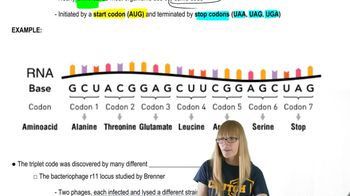
Begin by explaining that the genetic code is a set of rules by which the sequence of nucleotides in DNA or RNA is translated into the sequence of amino acids in proteins. Emphasize that it is nearly universal and consists of codons, which are triplets of nucleotides.
Describe the key properties of the genetic code: it is triplet-based (each codon consists of three nucleotides), non-overlapping (each nucleotide is part of only one codon), degenerate (multiple codons can code for the same amino acid), and has specific start and stop codons that signal the beginning and end of protein synthesis.
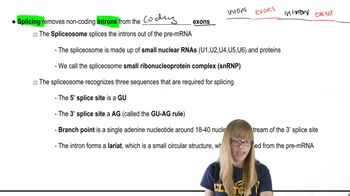
Next, introduce the process of transcription, where RNA is synthesized from a DNA template. Explain that transcription occurs in the nucleus of eukaryotic cells and involves copying a gene's DNA sequence into messenger RNA (mRNA).
Outline the main steps of transcription: initiation (RNA polymerase binds to the promoter region of DNA), elongation (RNA polymerase moves along the DNA template strand, synthesizing RNA in the 5' to 3' direction by complementary base pairing), and termination (RNA polymerase reaches a terminator sequence and releases the newly formed RNA transcript).
Conclude by noting that the RNA transcript carries the genetic information from DNA to the ribosome, where it will be translated into a protein, thus linking the genetic code to gene expression.

Verified video answer for a similar problem:
This video solution was recommended by our tutors as helpful for the problem above.
Video duration:
1mWas this helpful?
Key Concepts
Here are the essential concepts you must grasp in order to answer the question correctly.
Properties of the Genetic Code
The genetic code consists of nucleotide triplets called codons, each specifying an amino acid. It is nearly universal, degenerate (multiple codons can code for the same amino acid), and non-overlapping, ensuring accurate protein synthesis. The code also includes start and stop codons that signal the beginning and end of translation.
Recommended video:
Guided course
The Genetic Code
Transcription Process
Transcription is the synthesis of RNA from a DNA template. RNA polymerase binds to the promoter region, unwinds the DNA, and assembles a complementary RNA strand by matching RNA nucleotides to the DNA template strand. This process produces messenger RNA (mRNA) that carries genetic information for protein synthesis.
Recommended video:
Guided course
mRNA Processing
DNA Template and RNA Complementarity
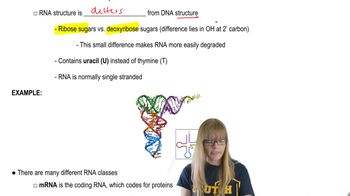
During transcription, the DNA template strand guides RNA synthesis through base pairing: adenine pairs with uracil (in RNA), and cytosine pairs with guanine. This complementarity ensures the RNA sequence accurately reflects the gene’s coding information, enabling correct translation into proteins.
Recommended video:
Related Practice
Textbook Question
632
views
Textbook Question
How were the specific sequences of triplet codes determined experimentally?
559
views
1
rank
Textbook Question
How were the experimentally derived triplet codon assignments verified in studies using bacteriophage MS2?
487
views
Textbook Question
Assuming the genetic code is a triplet, what effect would the addition or loss of two nucleotides have on the reading frame? The addition or loss of three, six, or nine nucleotides?
951
views
Textbook Question
The mRNA formed from the repeating tetranucleotide UUAC incorporates only three amino acids, but the use of UAUC incorporates four amino acids. Why?
704
views
Textbook Question
In studies using repeating copolymers, AC . . . incorporates threonine and histidine, and CAACAA . . . incorporates glutamine, asparagine, and threonine. What triplet code can definitely be assigned to threonine?
739
views