Pearson+ LogoPearson+ Logo
Ch. 14 - Translation and Proteins
Klug - Concepts of Genetics  12th Edition
Klug12th EditionConcepts of Genetics ISBN: 9780135564776Not the one you use?Change textbook
Chapter 14, Problem 31

Exon shuffling is a proposal that relates exons in DNA to the repositioning of functional domains in proteins. What evidence exists in support of exon shuffling?

Verified step by step guidance
1
Exon shuffling is a process that suggests exons, which are coding sequences in DNA, can be rearranged to create new proteins with novel functions.
One piece of evidence supporting exon shuffling is the presence of homologous exons in different genes, which suggests that these exons have been reused in different genetic contexts.
Another evidence is the modular nature of proteins, where distinct functional domains often correspond to individual exons, indicating that these domains may have been shuffled to create new proteins.
The presence of introns, which are non-coding sequences, between exons in eukaryotic genes provides the necessary flexibility for exon shuffling to occur during evolution.
Comparative genomics studies have shown that exon shuffling can lead to the rapid evolution of new genes, as seen in the diversity of immune system proteins.

Verified video answer for a similar problem:

This video solution was recommended by our tutors as helpful for the problem above.
Video duration:
2m
Was this helpful?

Key Concepts

Here are the essential concepts you must grasp in order to answer the question correctly.

Exons and Introns

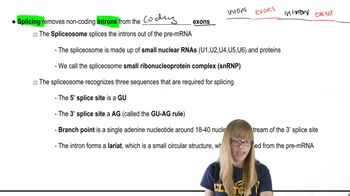
Exons are the coding regions of a gene that are expressed in the final mRNA product, while introns are non-coding regions that are spliced out during RNA processing. Understanding the distinction between exons and introns is crucial for grasping how exon shuffling can lead to the creation of new protein functions by rearranging these coding sequences.
Recommended video:
Guided course
08:39
mRNA Processing

Protein Domains

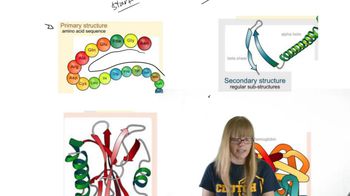
Protein domains are distinct functional and structural units within a protein, often responsible for specific activities or interactions. The concept of exon shuffling suggests that by rearranging exons, which correspond to these domains, new proteins with novel functions can be generated, highlighting the evolutionary significance of this mechanism.
Recommended video:

Evolutionary Evidence

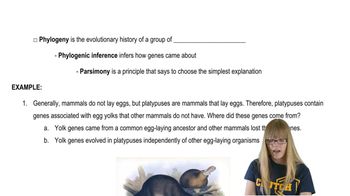
Evidence for exon shuffling comes from comparative genomics and the observation of similar protein domains across different species. Studies have shown that many proteins share common domains, suggesting that these domains have been rearranged through exon shuffling over evolutionary time, leading to increased protein diversity and adaptability.
Recommended video:
Related Practice
Textbook Question

List three different types of posttranslational modifications that may happen to a protein and the significance of each in the context of protein function.

441
views
Textbook Question

Why are misfolded proteins a potential problem for the eukaryotic cell, and how do cells combat the accumulation of misfolded proteins?

636
views
Textbook Question

How does an enzyme function? Why are enzymes essential for living organisms on Earth?

717
views
Textbook Question

Three independently assorting genes (A, B, and C) are known to control the following biochemical pathway that provides the basis for flower color in a hypothetical plant:

Three homozygous recessive mutations are also known, each of which interrupts a different one of these steps. Determine the phenotypic results in the F1 and F2 generations resulting from the P1 crosses of true-breeding plants listed here:

speckled (AABBCC) × yellow (AAbbCC)

845
views
Textbook Question

Three independently assorting genes (A, B, and C) are known to control the following biochemical pathway that provides the basis for flower color in a hypothetical plant:

Three homozygous recessive mutations are also known, each of which interrupts a different one of these steps. Determine the phenotypic results in the F1 and F2 generations resulting from the P1 crosses of true-breeding plants listed here:

yellow (AAbbCC) × green (AABBcc)

529
views
Textbook Question

Three independently assorting genes (A, B, and C) are known to control the following biochemical pathway that provides the basis for flower color in a hypothetical plant:

Three homozygous recessive mutations are also known, each of which interrupts a different one of these steps. Determine the phenotypic results in the F1 and F2 generations resulting from the P1 crosses of true-breeding plants listed here:

colorless (aaBBCC) × green (AABBcc)

676
views